Introduction
When businesses or individuals need professional translation services, one common question is:
“What is the difference between certified translation and standard translation?”
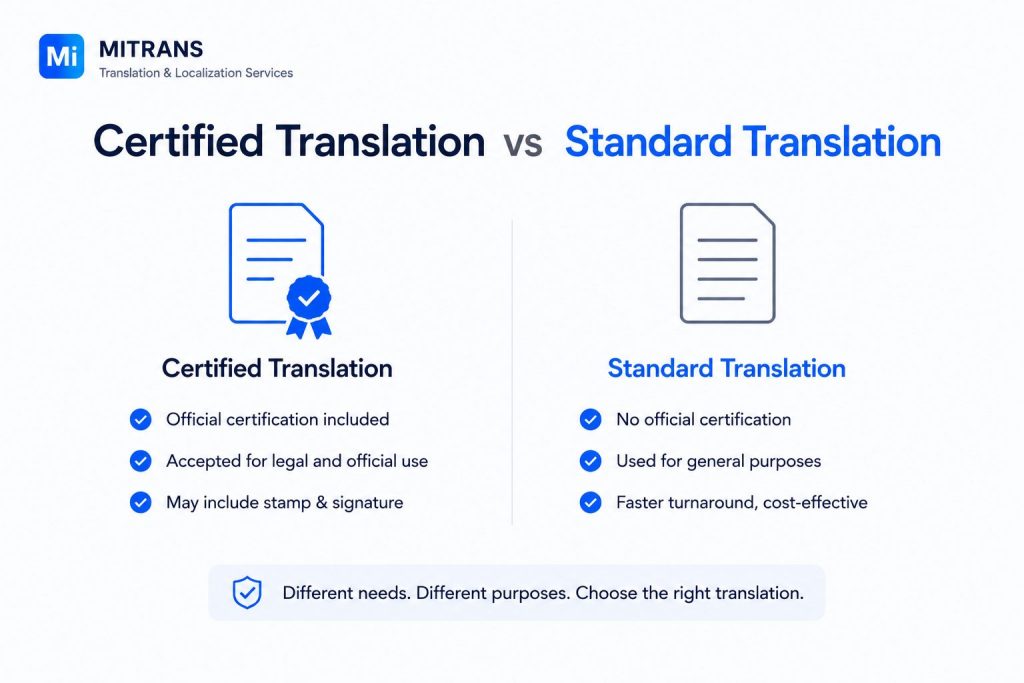
While both involve translating content accurately from one language to another, certified translation includes additional legal or official validation requirements that standard translation does not.
Understanding the difference is important because using the wrong type of translation may lead to document rejection, compliance issues, or delays in legal and administrative processes.
This guide explains the key differences between certified translation and standard translation, when each type is required, and how businesses can choose the right solution.
![Certified Translation vs Standard Translation — clean corporate banner with official documents, multilingual translation, and professional business communication theme]
What Is Standard Translation?
Standard translation refers to general professional translation without formal legal certification.
It is commonly used for:
- Websites
- Marketing materials
- Internal business communication
- Product descriptions
- Technical manuals
- Business reports
- Emails and presentations
The primary goal of standard translation is to communicate content accurately and naturally.
What Is Certified Translation?
Certified translation is a professional translation accompanied by an official statement confirming that:
- The translation is accurate
- The content matches the original document
- The translator or translation company takes responsibility for the translation quality
Certified translation is often required for:
- Immigration documents
- Legal paperwork
- Government submissions
- Academic documents
- Official certificates
- Court documents
In many cases, certified translation may also involve:
- Company stamps
- Translator signatures
- Notarization
- Legalization procedures
Key Differences Between Certified & Standard Translation
| Certified Translation | Standard Translation |
|---|---|
| Includes official certification | No formal certification |
| Often required for legal/official use | Used for general communication |
| May include stamps & signatures | No legal validation needed |
| Higher compliance requirements | More flexible workflow |
| Common for immigration/legal documents | Common for websites & business content |
The main difference is whether the translation needs official legal recognition.
When Businesses Need Certified Translation
Immigration & Visa Applications
Certified translation is commonly required for:
- Birth certificates
- Marriage certificates
- Criminal records
- Diplomas
- Identity documents
Government authorities often require officially certified translations.
Legal Documents
Businesses may need certified translation for:
- Contracts
- Court documents
- Power of attorney paperwork
- Business licenses
Accuracy and legal validity are critical.
Academic Documents
Students and professionals may require certified translation for:
- Diplomas
- Academic transcripts
- Certificates
- Educational records
Government & Administrative Procedures
Official submissions often require:
- Certified translation
- Notarization
- Consular legalization
Requirements vary by country and institution.
When Standard Translation Is Enough
Standard translation is usually suitable for:
- Website localization
- Marketing campaigns
- Product documentation
- Internal reports
- Customer communication
- Technical manuals
- Multilingual SEO content
These projects focus more on communication quality and localization rather than legal certification.
Why Accuracy Matters in Both Types
Whether certified or standard, professional translation should still maintain:
- Accuracy
- Terminology consistency
- Natural phrasing
- Proper formatting
Poor translation may:
- Damage credibility
- Create misunderstandings
- Delay official procedures
- Reduce customer trust
Professional human review remains important in both cases.
Common Challenges in Certified Translation
Strict Formatting Requirements
Certified documents often require:
- Matching formatting
- Signatures
- Stamps
- Official layouts
Legal Terminology Accuracy
Legal and official documents require precise terminology.
Small translation errors may create:
- Rejection risks
- Compliance issues
- Administrative delays
Country-Specific Requirements
Certification rules vary depending on:
- Country
- Government agency
- Institution
- Legal process
Businesses should verify requirements before submitting documents.
Certified Translation vs Notarized Translation
These terms are sometimes confused, but they are not always the same.
Certified Translation
Confirms translation accuracy.
Notarized Translation
Adds notarization by an authorized notary public.
Some processes may require:
- Certified translation only
- Certified + notarized translation
- Additional legalization
How to Choose the Right Translation Service
Businesses and individuals should consider:
- Purpose of the document
- Government or institutional requirements
- Industry expertise
- Translation quality
- Confidentiality handling
For official use, always confirm whether certification is required before starting the project.
How MITRANS Can Help
MITRANS Translation Services provides both certified translation and standard translation services for businesses and individuals in Vietnam.
MITRANS supports:
- Certified translation
- Business document translation
- Legal translation
- Technical translation
- Website localization
- Multilingual communication support
Languages supported include:
- English
- Vietnamese
- Chinese
- Japanese
- Korean
Why clients choose MITRANS:
- Professional native linguists
- Human quality assurance
- Accurate terminology management
- Confidential workflows
- Fast turnaround times
- Nationwide support across Vietnam
MITRANS helps clients manage both official document translation and multilingual business communication professionally and accurately.
FAQ
What is certified translation?
Certified translation includes an official statement confirming the accuracy and completeness of the translated document.
When is certified translation required?
Certified translation is commonly required for immigration, legal, academic, and government-related documents.
Is notarized translation the same as certified translation?
Not always. Notarized translation includes additional legal notarization procedures beyond certification.
Can websites or marketing materials use certified translation?
Most websites and marketing content only require standard professional translation and localization.
Does MITRANS provide certified translation services in Vietnam?
Yes. MITRANS provides professional certified translation services for official, legal, academic, and business documents.
Need Certified or Professional Translation Support?
Looking for accurate and reliable translation services for official documents or business communication?
Contact MITRANS today for professional certified translation and multilingual support tailored to your needs.