Introduction
Businesses and individuals often need translation services for many types of documents, including:
- Contracts
- Academic records
- Immigration documents
- Legal paperwork
- Business certificates
- Financial documents
One common question people ask is:
What is the difference between certified translation and standard translation?
Although both involve converting content from one language to another, they serve different purposes and may be required in different situations.
Choosing the wrong type of translation can lead to:
- Document rejection
- Legal complications
- Delays in processing
- Compliance issues
This guide explains the differences between certified translation and standard translation, when each is needed, and how businesses can choose the right solution.
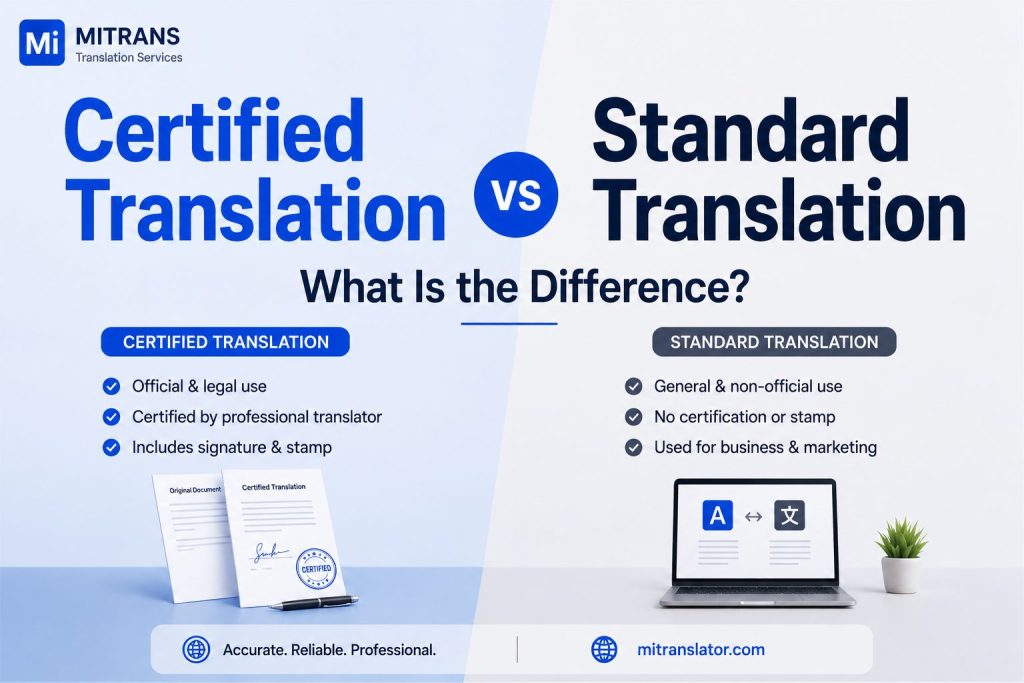
![Certified Translation vs Standard Translation — clean corporate banner with document translation, certification workflow, and multilingual business communication theme]
What Is Standard Translation?
Standard translation refers to general translation services used for:
- Websites
- Marketing content
- Product pages
- Internal business communication
- User manuals
- Blog articles
The primary goal is to communicate information accurately and naturally in another language.
Standard translation is commonly used for:
- Business operations
- Localization
- International communication
- Marketing adaptation
What Is Certified Translation?
Certified translation is a formally verified translation used for official or legal purposes.
It often includes:
- Translator certification statement
- Signature
- Company stamp or seal
- Verification of translation accuracy
Certified translations are commonly required for:
- Immigration applications
- Academic transcripts
- Birth certificates
- Marriage certificates
- Legal contracts
- Government submissions
Requirements may vary depending on the country or institution.
Main Differences Between Certified & Standard Translation
Purpose
| Standard Translation | Certified Translation |
|---|---|
| General communication | Official/legal use |
| Marketing & business content | Government & institutional documents |
| Localization & UX adaptation | Compliance & verification |
Accuracy Requirements
Certified translations usually require:
- Higher formal accuracy
- Exact terminology consistency
- Strict formatting compliance
Because official authorities may review the document carefully.
Certification Process
Certified translation may include:
- Signed declaration
- Translation certification statement
- Official company seal
Standard translation typically does not require formal certification.
Formatting Requirements
Certified translations often preserve:
- Original structure
- Layout formatting
- Official terminology
- Document appearance
This helps ensure acceptance by institutions or authorities.
When Businesses Need Standard Translation
Standard translation is commonly used for:
- Website localization
- SaaS localization
- Marketing campaigns
- Product descriptions
- Business presentations
- Internal documentation
The focus is usually on:
- Readability
- User experience
- Localization quality
- Customer engagement
When Certified Translation Is Required
Certified translation may be required for:
- Visa applications
- Immigration procedures
- Legal documentation
- Court documents
- Government submissions
- Academic applications
Businesses working internationally may also require certified translation for:
- Business registration
- Compliance documentation
- International contracts
Why Localization Matters Beyond Translation
For business content, direct translation is often not enough.
Professional localization may include:
- Vietnamese SEO localization
- UX adaptation
- Cultural adaptation
- Marketing tone adjustment
- Customer communication optimization
Localization helps communication feel natural and effective for Vietnamese audiences.
Common Mistakes Businesses Make
Using Standard Translation for Official Documents
Some institutions require certified translation specifically.
Submitting uncertified documents may cause delays or rejection.
Prioritizing Price Over Accuracy
Low-quality translation may create:
- Legal risks
- Miscommunication
- Brand inconsistency
- Compliance issues
Ignoring Localization Needs
Business communication often requires localization — not just direct translation.
Using Machine Translation for Legal Documents
AI translation tools may help with drafts, but human review remains essential for:
- Legal accuracy
- Terminology consistency
- Official compliance
Translation vs Localization
| Translation | Localization |
|---|---|
| Converts language | Adapts communication for local audiences |
| Focuses on wording | Focuses on UX, culture & engagement |
| Basic multilingual support | Market-focused adaptation |
| Literal communication possible | Natural audience-focused communication |
Localization improves communication quality for business growth and customer engagement.
Why Professional Translation Matters
Professional translation helps businesses:
- Improve credibility
- Reduce legal risk
- Build customer trust
- Improve global communication
- Maintain brand consistency
For official documents, accuracy and certification may be legally important.
How MITRANS Can Help
MITRANS Translation Services provides both certified translation and professional business localization services for international clients.
MITRANS supports:
- Certified document translation
- Legal translation
- Business translation
- Website localization
- SaaS localization
- Vietnamese SEO localization
- Marketing localization
- Multilingual business workflows
Languages supported include:
- English
- Vietnamese
- Chinese
- Japanese
- Korean
Why clients choose MITRANS:
- Native linguists
- Human quality assurance
- Localization-focused workflows
- Official translation support
- Industry-specialized expertise
- Fast turnaround service
MITRANS helps businesses and individuals communicate accurately, professionally, and confidently across international markets.
FAQ
What is the difference between certified and standard translation?
Certified translation includes formal verification for official use, while standard translation is typically used for general communication and business content.
When do I need certified translation?
Certified translation is often required for immigration, legal documents, academic records, and government submissions.
Is website translation considered certified translation?
No. Website localization and marketing translation are usually standard translation services.
Can AI translation be used for certified documents?
AI tools may help with drafts, but certified translation requires professional human review and verification.
Does MITRANS provide certified translation services?
Yes. MITRANS provides professional certified translation and multilingual localization support for businesses and individuals.
Need Certified or Business Translation Support?
Looking for reliable translation services for official documents or international business communication?
Contact MITRANS today for professional multilingual support tailored to your needs.