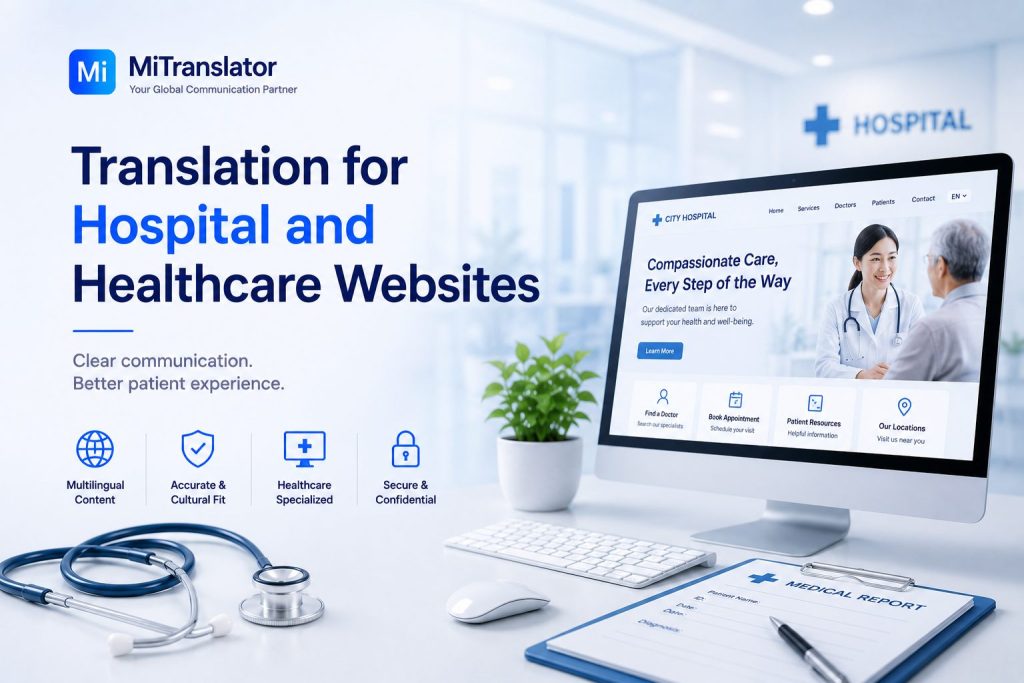
In today’s digital-first healthcare environment, a hospital or healthcare organization’s website is often the first point of contact for patients seeking medical information, scheduling appointments, or exploring treatment options. As healthcare providers increasingly serve international patients and multicultural communities, offering website content in multiple languages has become a necessity rather than a competitive advantage.
A well-translated healthcare website helps patients access essential information, understand available services, and communicate confidently with healthcare providers. On the other hand, inaccurate or poorly localized content can create confusion, reduce trust, and potentially affect patient outcomes.
This is why professional translation for hospital and healthcare websites plays a critical role in improving accessibility, enhancing patient experiences, and supporting global healthcare services.
What Is Translation for Hospital and Healthcare Websites?
Translation for hospital and healthcare websites involves translating and localizing website content to make it accessible, accurate, and culturally appropriate for multilingual audiences.
Healthcare website translation may include:
- Service descriptions
- Doctor and specialist profiles
- Patient resources
- Appointment booking systems
- Medical department information
- Treatment and procedure descriptions
- Patient forms
- FAQs
- Health education articles
- Privacy policies and legal notices
The goal is to ensure that patients can easily access and understand healthcare information regardless of their language background.
Why Healthcare Website Translation Matters
Improving Patient Accessibility
Patients often search online for healthcare information before contacting a provider.
A multilingual website allows patients to:
- Learn about medical services
- Understand treatment options
- Find healthcare providers
- Schedule appointments
- Access patient resources
Providing information in multiple languages helps eliminate communication barriers and improves accessibility.
Building Patient Trust
Healthcare decisions are highly personal and often involve sensitive information.
Patients are more likely to trust a healthcare provider when they can access information in their native language.
Clear communication helps create confidence and encourages patient engagement.
Supporting International Patients
Many hospitals and clinics serve international patients seeking specialized treatments, second opinions, or medical tourism services.
Translated websites help international visitors understand:
- Available treatments
- Medical specialties
- Admission procedures
- Costs and payment options
- Travel-related healthcare information
This improves the overall patient experience and supports international outreach efforts.
Enhancing Search Visibility
Website translation can also support international search engine optimization (SEO).
Multilingual content helps healthcare organizations appear in search results for users searching in different languages, increasing visibility and attracting a broader audience.
Common Content Requiring Translation
Medical Service Pages
Service pages explain healthcare offerings and treatment options.
Examples include:
- Cardiology services
- Oncology treatments
- Orthopedic care
- Pediatric services
- Surgical procedures
Accurate translation helps patients understand available care options.
Doctor and Specialist Profiles
Patients often review physician qualifications before choosing a provider.
Professional translation ensures that credentials, specialties, and professional experience are communicated accurately.
Patient Education Content
Healthcare websites frequently publish educational materials such as:
- Health guides
- Disease information
- Prevention tips
- Treatment explanations
- Wellness resources
Clear translation helps patients make informed healthcare decisions.
Appointment and Registration Systems
Online forms, scheduling systems, and patient portals should be translated to improve usability and reduce registration errors.
Legal and Privacy Information
Healthcare organizations must provide information regarding:
- Privacy policies
- Data protection practices
- Terms of use
- Patient rights
Accurate translation supports transparency and regulatory compliance.
Challenges in Healthcare Website Translation
Complex Medical Terminology
Healthcare websites contain specialized medical language that requires expert translation.
Examples include:
- Medical conditions
- Diagnostic procedures
- Treatment protocols
- Pharmaceutical information
- Healthcare regulations
Translators must understand medical terminology to ensure accuracy.
Patient Safety Considerations
Inaccurate healthcare information can create misunderstandings that may affect patient decisions.
Translation quality is critical when communicating health-related content.
Cultural Differences
Healthcare communication varies between cultures.
Medical concepts, communication styles, and patient expectations may require localization to ensure relevance and understanding.
Maintaining Consistency Across Large Websites
Healthcare organizations often manage extensive websites containing hundreds or thousands of pages.
Maintaining consistent terminology across all content can be challenging without structured translation processes.
Ongoing Content Updates
Healthcare websites are regularly updated with new services, articles, and announcements.
Translations must be maintained to ensure all language versions remain accurate and current.
Best Practices for Healthcare Website Localization
Use Professional Medical Translators
Healthcare content should be translated by professionals with medical expertise.
Specialized translators understand healthcare terminology and can communicate complex information accurately.
Localize Content for Target Audiences
Localization involves adapting content to reflect:
- Cultural expectations
- Local healthcare terminology
- Communication preferences
- Regional language variations
Localization improves engagement and comprehension.
Maintain Consistent Medical Terminology
A standardized medical glossary helps ensure consistency across website pages, patient resources, and marketing materials.
Optimize for Multilingual SEO
Healthcare organizations should optimize translated content using relevant keywords for each target language and market.
This helps improve visibility in international search results.
Conduct Quality Assurance Reviews
Healthcare websites should undergo comprehensive reviews to verify:
- Translation accuracy
- Terminology consistency
- User experience
- Functional performance
- Regulatory compliance
Quality assurance helps deliver a professional and trustworthy online experience.
Healthcare Website Translation Checklist
Before launching a multilingual healthcare website, ensure that you:
✔ Translate all patient-facing content professionally
✔ Verify medical terminology accuracy
✔ Localize content for target audiences
✔ Translate appointment and registration systems
✔ Review legal and privacy information
✔ Maintain terminology consistency
✔ Optimize content for multilingual SEO
✔ Test website functionality across languages
✔ Update translations regularly
✔ Conduct final quality assurance reviews
How MITRANS Can Help
Healthcare website translation requires a combination of medical expertise, localization knowledge, and digital content experience.
MITRANS provides professional translation and localization services for:
- Hospital websites
- Clinic websites
- Healthcare portals
- Medical tourism websites
- Telemedicine platforms
- Patient education content
- Doctor profiles
- Healthcare marketing materials
- Appointment systems
- Healthcare compliance content
Our experienced medical translators help healthcare organizations create accessible, accurate, and culturally appropriate websites that support patients across multiple languages and markets.
Frequently Asked Questions
Why is healthcare website translation important?
Healthcare website translation improves accessibility, enhances patient trust, supports international patients, and helps healthcare organizations reach broader audiences.
What healthcare website content should be translated?
Common content includes service pages, doctor profiles, appointment systems, patient education materials, privacy policies, and healthcare resources.
What is the difference between translation and localization?
Translation converts content into another language, while localization adapts it to fit cultural, linguistic, and regional expectations.
Can machine translation be used for healthcare websites?
Machine translation may help with basic content, but professional human translation is recommended for healthcare information where accuracy and patient understanding are critical.
How often should healthcare website translations be updated?
Translations should be reviewed whenever new services, content, regulations, or website features are introduced.
Conclusion
A multilingual healthcare website helps hospitals, clinics, and healthcare organizations connect with diverse patient populations while improving accessibility and trust. Accurate translation ensures that patients can easily understand medical information, access healthcare services, and make informed decisions about their care.
By investing in professional healthcare website translation and localization services, organizations can enhance patient experiences, support international growth, and strengthen their digital presence in global healthcare markets.
Need Translation Support for Your Hospital or Healthcare Website?
Looking to translate your hospital website, clinic portal, patient resources, or healthcare content for multilingual audiences?
Contact MITRANS today for fast, accurate, and professional healthcare website translation and localization services tailored to hospitals, clinics, medical centers, telemedicine providers, healthcare networks, and medical tourism organizations.