
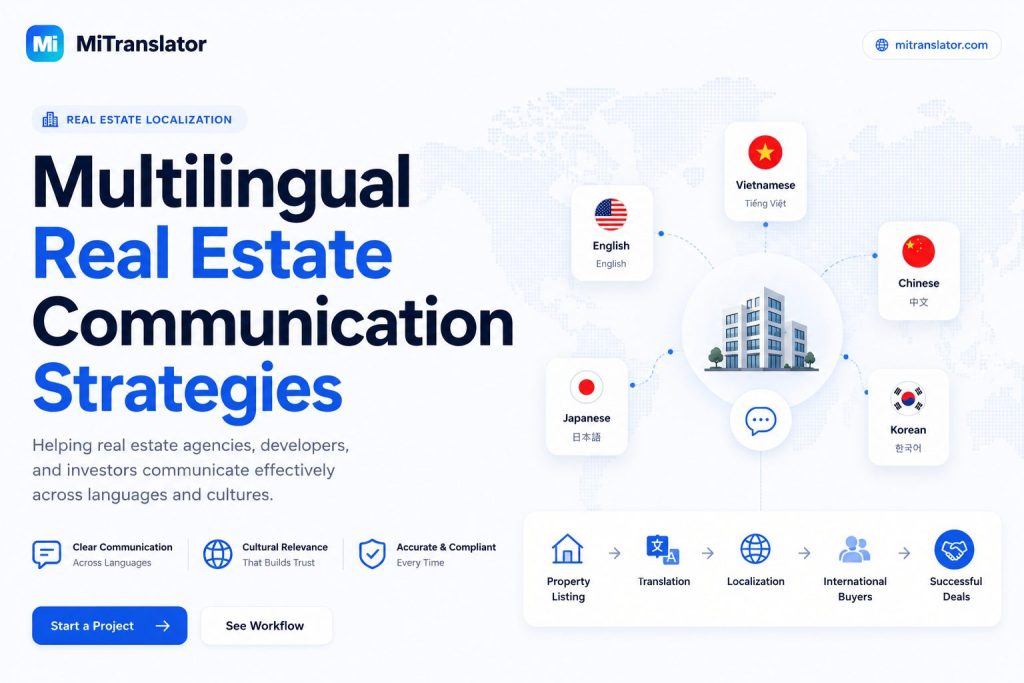
The real estate industry is becoming increasingly international. Property developers, real estate agencies, and investment firms are no longer targeting only local buyers—they are attracting investors, expatriates, and homebuyers from around the world.
However, reaching international audiences requires more than simply translating property listings. Effective multilingual real estate communication strategies help businesses build trust, improve customer experiences, and increase conversions across diverse markets.
From property descriptions and websites to legal contracts and customer support, every touchpoint must be clear, culturally appropriate, and linguistically accurate. In this guide, we’ll explore why multilingual communication matters in real estate, common challenges businesses face, and practical strategies for engaging global property buyers and investors.
What Are Multilingual Real Estate Communication Strategies?
Multilingual real estate communication strategies refer to the processes and tools used to communicate effectively with clients, investors, tenants, and stakeholders who speak different languages.
These strategies typically include:
- Translating property listings and brochures
- Localizing real estate websites
- Providing multilingual customer support
- Translating contracts and legal documents
- Offering interpretation services during meetings and negotiations
- Adapting marketing campaigns for international audiences
The objective is to ensure that potential buyers and investors fully understand property information while feeling confident and comfortable throughout the purchasing process.
Why Multilingual Communication Matters in Real Estate
Expanding Access to International Buyers
Foreign investors and international homebuyers often begin their property search online. If listings, websites, and marketing materials are only available in one language, businesses may lose valuable opportunities.
Providing multilingual content helps attract a wider audience and increases visibility in global markets.
Building Trust with Prospective Clients
Real estate transactions involve significant financial commitments. Buyers need to understand every detail before making a decision.
When information is presented in a client’s native language, it reduces uncertainty and creates a stronger sense of trust.
Improving Customer Experience
Language accessibility can significantly improve the buyer journey by making it easier to:
- Browse property listings
- Request information
- Schedule property viewings
- Negotiate terms
- Complete documentation
A positive customer experience often leads to higher conversion rates and stronger client relationships.
Supporting Cross-Border Property Transactions
International real estate deals frequently involve multiple parties, including buyers, sellers, developers, banks, and legal professionals.
Clear multilingual communication helps ensure that all stakeholders remain aligned throughout the transaction process.
Common Challenges in Multilingual Real Estate Communication
Language Barriers
Even minor translation errors can cause confusion regarding property specifications, pricing structures, payment terms, or ownership rights.
Accurate communication is essential to avoid misunderstandings that may delay transactions.
Complex Legal Terminology
Real estate contracts contain specialized legal language that often varies between jurisdictions.
Incorrect translations may lead to compliance issues, contractual disputes, or misunderstandings regarding legal obligations.
Cultural Differences
Different markets have unique communication styles and expectations.
Marketing messages that resonate with buyers in one country may not be effective in another. Understanding cultural nuances is essential when targeting international audiences.
Inconsistent Messaging Across Channels
Using different translators, automated translation tools, or unverified terminology can create inconsistencies across:
- Property listings
- Websites
- Marketing materials
- Contracts
- Customer communications
Consistent terminology helps maintain professionalism and brand credibility.
Best Practices for Multilingual Real Estate Communication
Invest in Professional Real Estate Translation
Professional translators understand industry-specific terminology and can accurately translate both marketing and legal content.
This is particularly important for:
- Property listings
- Purchase agreements
- Lease contracts
- Investment proposals
- Marketing brochures
Localize Content for Target Markets
Localization goes beyond direct translation by adapting content to local cultural expectations and market preferences.
This may include:
- Currency conversion
- Local measurement units
- Market-specific terminology
- Cultural adaptations
- Regionally relevant messaging
Create Multilingual Property Listings
Property descriptions should be professionally translated into the languages of target buyers.
Clear and accurate listings help international clients better understand property features, amenities, locations, and investment opportunities.
Offer Multilingual Customer Support
Providing customer support in multiple languages enhances client satisfaction and improves communication throughout the sales process.
Buyers are often more comfortable discussing major financial decisions in their native language.
Use Certified Translation for Legal Documents
Many international property transactions require certified translations for contracts, title deeds, permits, and supporting documents.
Certified translations ensure legal accuracy and acceptance by relevant authorities.
Maintain Consistent Terminology
Creating a standardized terminology database helps ensure consistency across all communication materials and strengthens brand professionalism.
Multilingual Real Estate Communication Checklist
Before launching an international real estate campaign, ensure that you:
✔ Translate all property listings professionally
✔ Localize marketing materials for target markets
✔ Provide multilingual website content
✔ Offer multilingual customer support
✔ Translate contracts and legal documents accurately
✔ Use certified translation when required
✔ Maintain consistent terminology across all channels
✔ Review content for cultural appropriateness
✔ Train teams on cross-cultural communication
✔ Implement quality assurance procedures
How MITRANS Can Help
Successful international real estate transactions depend on clear and accurate communication.
MITRANS provides professional language solutions tailored to the real estate industry, including:
- Real estate document translation
- Property listing translation
- Contract and agreement translation
- Certified translation services
- Website localization
- Multilingual marketing content translation
- Interpretation services for meetings and negotiations
With expertise in English, Chinese, Japanese, Korean, and many other languages, MITRANS helps real estate professionals communicate confidently with global buyers and investors.
Frequently Asked Questions
Why is multilingual communication important in real estate?
It helps businesses connect with international buyers, improve customer experiences, reduce misunderstandings, and increase opportunities in global property markets.
Which real estate documents typically require translation?
Common documents include property listings, contracts, title deeds, lease agreements, investment reports, permits, and marketing materials.
What is the difference between translation and localization?
Translation converts content from one language to another, while localization adapts content to fit the cultural and market expectations of a specific audience.
Are certified translations necessary for property transactions?
In many international transactions, certified translations may be required by banks, legal authorities, government agencies, or immigration offices.
Can machine translation be used for real estate documents?
Machine translation may help with basic understanding, but professional human translation is strongly recommended for legal, financial, and marketing materials.
Conclusion
As real estate markets become increasingly global, multilingual communication is no longer optional. Businesses that invest in effective multilingual real estate communication strategies can reach wider audiences, build stronger relationships with international clients, and facilitate smoother cross-border transactions.
By combining professional translation, localization, and interpretation services, real estate professionals can overcome language barriers and unlock new opportunities in international property markets.
Need Multilingual Real Estate Communication Support for Global Property Markets?
Looking to connect with international property buyers, investors, and real estate partners through clear, localized communication?
Contact MITRANS today for fast, accurate, and professional real estate translation and localization services tailored to developers, agencies, property management companies, real estate portals, and global property brands.