
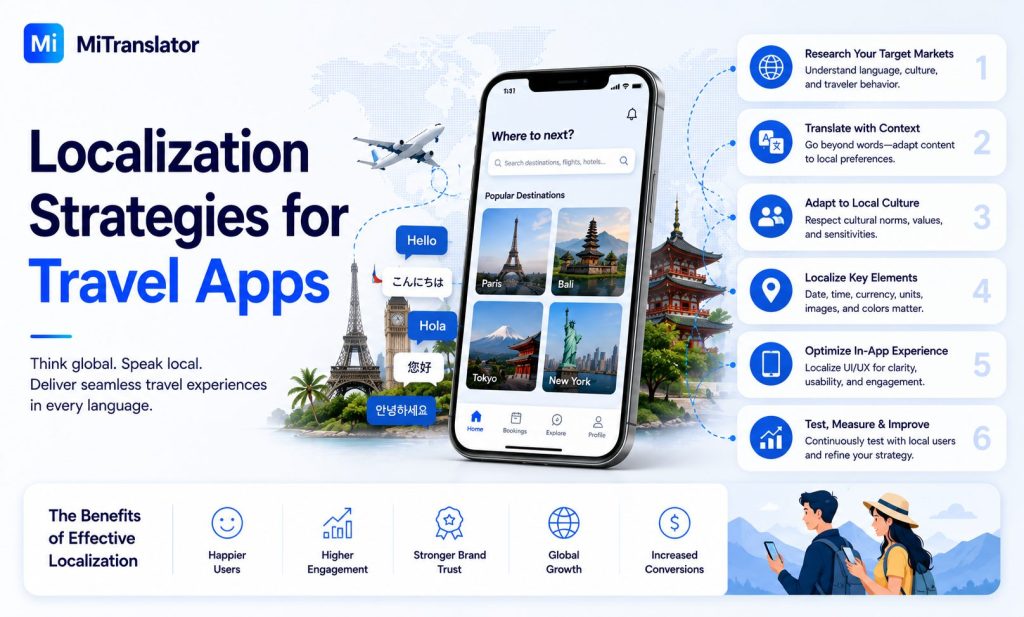
Mobile applications have transformed the way people travel. From booking flights and hotels to discovering attractions, navigating unfamiliar destinations, and managing itineraries, travel apps have become an essential part of the modern travel experience. As travel companies expand into international markets, simply translating an app into multiple languages is no longer enough. To succeed globally, travel apps must provide localized experiences that feel natural and relevant to users in different regions.
Localization helps travel apps adapt to local languages, cultural expectations, payment preferences, user behaviors, and regional regulations. A well-localized travel app can improve user satisfaction, increase engagement, boost downloads, and drive higher booking conversions. In contrast, poorly localized apps may confuse users, reduce trust, and limit growth opportunities in international markets.
This article explores localization strategies for travel apps, why they matter, common challenges developers face, and best practices for creating successful multilingual travel applications.
What Are Localization Strategies for Travel Apps?
Localization strategies for travel apps involve adapting an application’s content, functionality, and user experience to meet the needs of users in specific markets.
Travel app localization often includes:
- User interface translation
- Destination content localization
- Multilingual customer support
- Currency adaptation
- Date and time formatting
- Payment method localization
- Push notification translation
- Booking process localization
- Travel guide adaptation
- Regional SEO and app store optimization
Unlike translation, localization goes beyond language conversion. It ensures that every aspect of the app aligns with local expectations and user behaviors.
For example, a travel app targeting Vietnamese users may need to display prices in Vietnamese Dong (VND), support local payment options, use familiar travel terminology, and provide culturally relevant travel recommendations.
A comprehensive localization strategy helps travel apps deliver a seamless user experience regardless of where users are located.
Why Localization Matters for Travel Apps
Improves User Experience
Users are more likely to engage with apps that feel familiar and easy to navigate.
Localized interfaces help users understand features, booking options, and travel information without language barriers.
Increases Booking Conversions
Travel decisions often involve significant spending. Users are more comfortable completing bookings when pricing, payment instructions, and policies are clearly presented in their preferred language.
Localization can reduce booking abandonment and increase conversion rates.
Expands Global Market Reach
Travel apps targeting international audiences need to communicate effectively across multiple languages and regions.
Localization helps businesses reach new markets and attract users who may not speak the app’s original language.
Builds Trust and Credibility
Localized content demonstrates that a company understands and values local users.
This can strengthen brand reputation and encourage long-term customer loyalty.
Supports Customer Retention
Travelers are more likely to continue using an app that consistently provides relevant and accessible experiences.
Localization contributes to higher user satisfaction and retention rates.
Enhances Competitive Advantage
In crowded travel markets, localization can differentiate an app from competitors that only provide limited language support.
A better localized experience often translates into stronger customer preference.
Common Challenges in Travel App Localization
Managing Large Volumes of Content
Travel apps often contain extensive content, including:
- Hotel listings
- Destination guides
- Activity descriptions
- User reviews
- Booking information
Maintaining consistency across multiple languages can be challenging.
Frequent Updates
Travel apps regularly introduce new features, destinations, promotions, and content updates.
Localization workflows must keep pace with ongoing changes to ensure consistency.
Inconsistent Terminology
Without standardized terminology, travel-related phrases may be translated differently throughout the application.
This can create confusion and reduce professionalism.
Cultural Differences
Travel habits and preferences vary significantly between markets.
Features and content that appeal to one audience may not resonate with users elsewhere.
User Interface Constraints
Some languages require more space than others, potentially affecting screen layouts, buttons, and navigation elements.
Localization teams must ensure usability remains intact across languages.
Payment and Booking Preferences
Different markets often prefer different payment methods and booking processes.
Failure to localize these elements can negatively affect conversion rates.
Best Practices for Travel App Localization
Conduct Market Research
Before localizing an app, understand the target market’s:
- Language preferences
- Travel behaviors
- Payment methods
- Cultural expectations
- Popular destinations
Research helps prioritize localization efforts and improve effectiveness.
Prioritize High-Impact Content
Focus first on content that directly affects user decisions, including:
- Booking interfaces
- Hotel descriptions
- Tour information
- Payment instructions
- Customer support content
These elements have the greatest impact on user experience and conversions.
Create Translation Glossaries
Develop multilingual terminology databases covering:
- Travel terminology
- Booking-related language
- Customer support phrases
- Destination categories
- Hospitality terminology
Consistent terminology improves user understanding and brand consistency.
Localize Payment Experiences
Adapt payment options to local market preferences.
Examples may include:
- Local bank transfers
- Mobile payment solutions
- Digital wallets
- Regional credit card providers
Localized payment experiences often increase transaction completion rates.
Optimize Push Notifications
Travel apps frequently rely on notifications to engage users.
Localized messages should reflect local language preferences and cultural communication styles while remaining concise and actionable.
Adapt Dates, Times, and Currency Formats
Users expect information to be displayed according to local conventions.
Ensure localization includes:
- Currency symbols
- Time zones
- Date formats
- Measurement units
This improves usability and reduces confusion.
Implement Continuous Localization
Localization should be integrated into the app development lifecycle.
Continuous localization allows new content and features to be translated and reviewed efficiently as updates are released.
Travel App Localization Checklist
Before launching a localized version of a travel app, verify that:
- User interface text is translated accurately.
- Travel terminology is consistent.
- Payment methods are localized.
- Currency formats are correct.
- Date and time displays follow local standards.
- Push notifications are localized.
- Quality assurance testing has been completed.
How MITRANS Can Help
Successful travel app localization requires expertise in language, user experience, travel industry terminology, and digital content adaptation.
MITRANS provides professional translation and localization services for travel technology companies, tourism platforms, hospitality businesses, and mobile application developers.
Our services include:
- Travel app localization
- Mobile app translation
- User interface localization
- Booking platform translation
- Travel content localization
- Customer support translation
- Push notification localization
- Multilingual SEO localization
- App store localization
- Linguistic testing and quality assurance
Our experienced linguists understand the travel industry’s unique requirements and help businesses create seamless multilingual experiences for users worldwide.
With expertise in English, Vietnamese, Chinese, Japanese, Korean, French, German, and many other languages, MITRANS helps travel brands expand globally and connect more effectively with international travelers.
Frequently Asked Questions About Travel App Localization
What is travel app localization?
Travel app localization is the process of adapting a travel application’s language, content, and functionality to meet the needs of users in specific regions and markets.
Why is localization important for travel apps?
Localization improves user experience, increases booking conversions, supports international expansion, and helps build customer trust.
What content should be localized in a travel app?
Important content includes user interfaces, booking workflows, destination guides, payment instructions, customer support materials, notifications, and marketing content.
How does localization differ from translation?
Translation focuses on language conversion, while localization adapts content, design, functionality, and user experiences to fit local market expectations.
Can localization increase app downloads and bookings?
Yes. Well-localized travel apps often achieve higher engagement, better user retention, improved conversion rates, and stronger performance in international markets.
Need Travel App Localization Support?
Looking to expand your travel app into new markets and deliver seamless multilingual experiences for global travelers?
Contact MITRANS today for fast, accurate, and professional travel app translation and localization services tailored to travel technology companies, booking platforms, and tourism businesses worldwide.