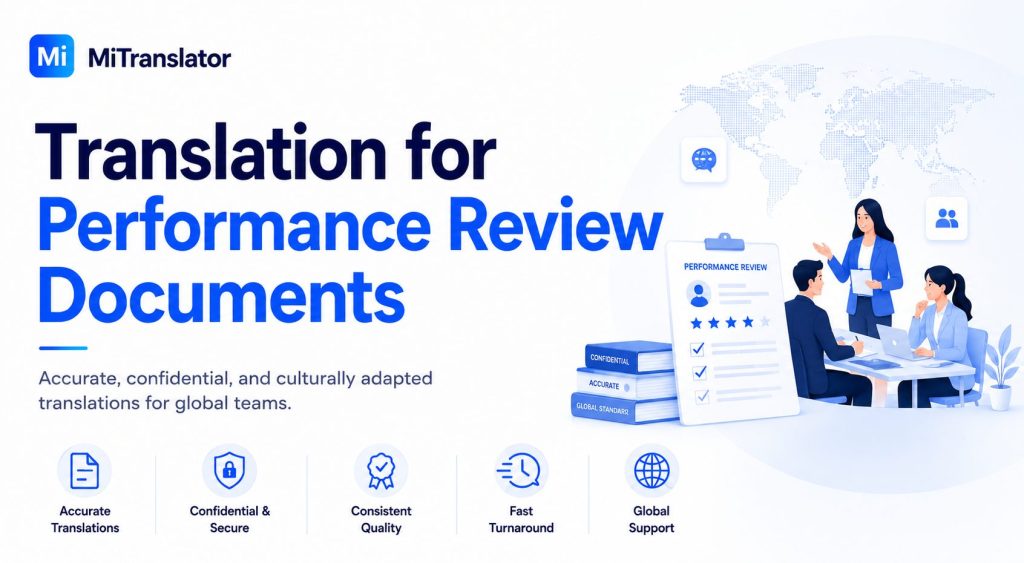
Performance reviews play a critical role in employee development, workforce management, and organizational success. They provide structured feedback, evaluate employee achievements, identify areas for improvement, and support decisions related to promotions, compensation, and career progression. As businesses expand globally and employ multilingual workforces, ensuring that performance review documents are accurately translated becomes increasingly important.
Poorly translated performance evaluations can lead to misunderstandings, employee dissatisfaction, compliance concerns, and inconsistent performance management practices. Organizations operating across borders must ensure that performance review documents are clear, culturally appropriate, and accurately reflect the intended message.
This article explores the importance of translating performance review documents, common challenges businesses face, best practices for ensuring accuracy, and how professional translation services can support effective employee evaluation processes.
What Is Translation for Performance Review Documents?
Translation for performance review documents involves converting employee evaluation materials from one language into another while preserving their meaning, tone, and intent. These documents are often highly sensitive because they directly impact employee performance assessments, career development, and workplace relationships.
Performance review documents may include:
- Annual performance evaluations
- Employee appraisal forms
- Manager feedback reports
- Self-assessment forms
- Performance improvement plans (PIPs)
- Goal-setting documents
- Competency assessments
- Promotion evaluation reports
- Employee development plans
- Performance rating guidelines
Unlike general business content, performance reviews often contain nuanced language, constructive feedback, and culturally sensitive expressions. Translators must accurately convey both positive and critical feedback while maintaining professionalism and fairness.
In multinational organizations, translated performance review documents help ensure that employees receive consistent evaluations regardless of their location or preferred language.
Why Translation for Performance Review Documents Matters for Businesses
Ensures Fair and Consistent Evaluations
Employees should be evaluated based on performance rather than language proficiency. Accurate translation helps ensure that all employees receive the same information and are assessed according to consistent standards.
Improves Employee Understanding
When employees can review feedback in their native language, they are more likely to understand expectations, strengths, development opportunities, and performance goals.
Supports Global Workforce Management
International organizations often conduct performance reviews across multiple countries. Translation helps standardize evaluation processes while maintaining alignment with corporate objectives.
Reduces Miscommunication
Even small translation errors can significantly alter the meaning of feedback. Professional translation reduces the risk of misunderstandings between managers and employees.
Enhances Employee Engagement
Clear communication demonstrates respect for employees and helps create a more inclusive workplace. Employees who fully understand their evaluations are more likely to engage in professional development initiatives.
Supports Legal and HR Compliance
Performance review records may be used in employment decisions, disputes, or regulatory audits. Accurate translations help organizations maintain reliable documentation and reduce legal risks.
Common Challenges in Translating Performance Review Documents
Preserving Tone and Intent
Performance evaluations often balance praise, constructive criticism, and development recommendations. Translators must preserve the original tone without making feedback appear harsher or weaker than intended.
Cultural Differences in Feedback Styles
Different cultures have varying expectations regarding workplace feedback. Some cultures value direct communication, while others prefer more indirect approaches. Translators must adapt content appropriately while preserving the original meaning.
HR and Management Terminology
Performance reviews frequently contain specialized HR terminology and competency frameworks. Inaccurate translation of these terms can create confusion and inconsistency.
Maintaining Confidentiality
Employee evaluations contain sensitive personal information. Organizations must ensure that translators follow strict confidentiality and data protection standards.
Consistency Across Global Offices
Multinational companies often use standardized evaluation frameworks. Maintaining consistent terminology and rating systems across multiple languages can be challenging.
Tight Review Cycles
Performance review periods typically involve large volumes of documentation within short deadlines. Companies need efficient translation processes without compromising quality.
Best Practices for Translating Performance Review Documents
Work With Professional HR Translators
Choose translators who have experience with HR documentation, employee evaluations, and corporate communication. Industry expertise helps ensure accuracy and professionalism.
Develop Standardized Terminology
Create multilingual glossaries for:
- Performance ratings
- Competency models
- Leadership criteria
- Career development terminology
- Organizational values
Standardized terminology improves consistency across all review documents.
Maintain Consistent Evaluation Frameworks
Ensure that rating scales, performance categories, and assessment criteria remain consistent across all language versions.
Prioritize Confidentiality
Implement secure document handling procedures and work with translation providers that follow strict confidentiality protocols.
Consider Cultural Localization
Adapt language where necessary to ensure feedback remains constructive and culturally appropriate without changing the evaluation outcome.
Implement Quality Assurance Processes
Every translated document should undergo review by qualified linguists and HR specialists to verify accuracy, consistency, and readability.
Leverage Translation Memory Tools
Translation memory technology helps maintain consistency across recurring review cycles while improving efficiency and reducing costs.
Translation Checklist for Performance Review Documents
Before finalizing translated performance reviews, verify that:
- Employee feedback is accurately conveyed.
- Performance ratings remain consistent.
- HR terminology is standardized.
- Cultural nuances have been considered.
- Confidential information is protected.
- Formatting and structure are preserved.
- Quality assurance reviews have been completed.
How MITRANS Can Help
Performance review documents require a high level of linguistic accuracy, cultural understanding, and confidentiality. Even minor translation errors can affect employee morale, performance management outcomes, and organizational trust.
MITRANS provides professional HR translation services designed to help organizations manage multilingual performance evaluation processes with confidence.
Our services include:
- Performance review translation
- Employee appraisal form translation
- Performance improvement plan translation
- HR policy translation
- Employee handbook translation
- Training material localization
- Internal communication translation
- HR document review and quality assurance
- Multilingual workforce communication support
Our experienced linguists understand the complexities of HR documentation and employee performance management. We ensure that translated evaluations maintain their intended meaning, tone, and professionalism while meeting organizational standards.
With support for English, Vietnamese, Chinese, Japanese, Korean, and many other languages, MITRANS helps businesses communicate effectively with employees across global operations.
Frequently Asked Questions About Performance Review Document Translation
Why should performance review documents be professionally translated?
Professional translation ensures that employee evaluations remain accurate, fair, and consistent while reducing the risk of misunderstandings and compliance issues.
Which performance management documents typically require translation?
Common documents include performance evaluations, self-assessments, goal-setting forms, competency assessments, development plans, and performance improvement plans.
How can companies protect confidentiality during translation?
Organizations should work with professional translation providers that follow strict confidentiality agreements, secure workflows, and data protection procedures.
Can performance review terminology be standardized across languages?
Yes. Using multilingual glossaries, style guides, and translation memory tools helps maintain consistency across all review documents.
Is localization necessary for performance reviews?
Yes. Localization helps ensure that feedback remains culturally appropriate and easily understood while preserving the original intent of the evaluation.
Need Professional HR Document Translation Support?
Looking to ensure accurate, confidential, and culturally appropriate performance reviews for your multilingual workforce?
Contact MITRANS today for fast, accurate, and professional HR translation services, including performance review documents, employee evaluations, HR policies, training materials, and workforce communication solutions tailored to your business needs.