As businesses expand into international markets, the volume of multilingual content they manage continues to grow. Large organizations often need to translate legal contracts, technical manuals, financial reports, compliance documents, websites, marketing materials, product catalogs, training resources, and internal communications into multiple languages simultaneously.
Managing these projects manually can quickly become overwhelming. Files may be scattered across emails, stakeholders may struggle to track project status, terminology can become inconsistent, and deadlines can be difficult to control. These challenges become even more significant when multiple departments, countries, vendors, and language pairs are involved.
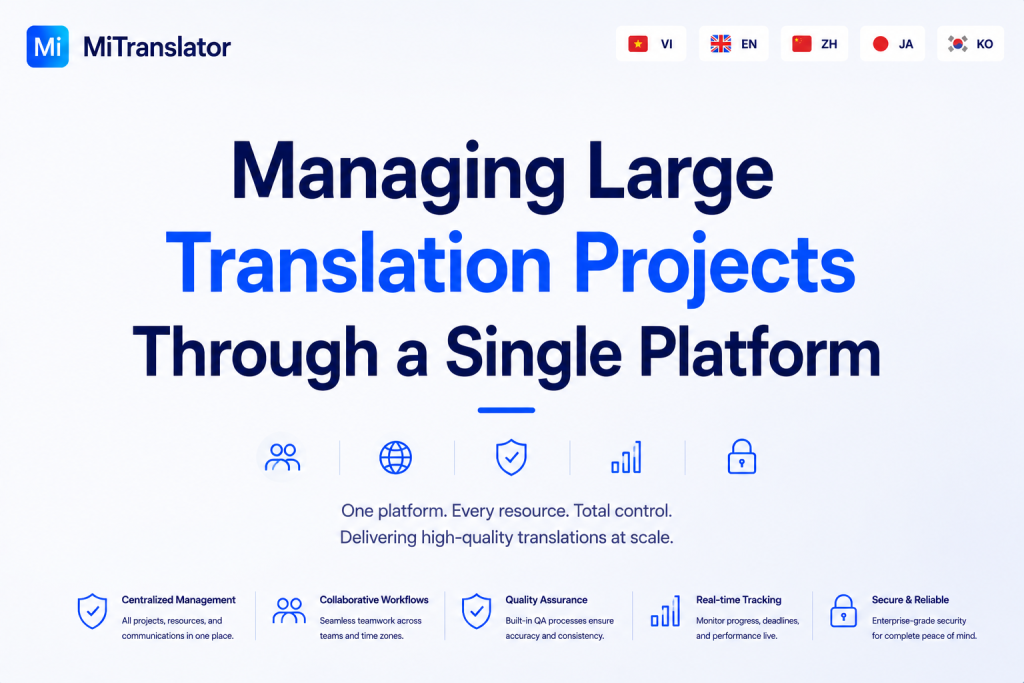
To address these complexities, many organizations are adopting centralized translation platforms that allow them to manage large-scale translation projects through a single system. A unified platform helps streamline workflows, improve visibility, enhance collaboration, and ensure consistent quality across all multilingual content.
Why Large Translation Projects Are Challenging
Large translation projects often involve multiple stakeholders, complex workflows, and substantial volumes of content.
Common challenges include:
- Managing thousands of pages of content
- Coordinating multiple translators and reviewers
- Tracking project progress
- Maintaining terminology consistency
- Meeting tight deadlines
- Managing document versions
- Protecting confidential information
- Controlling translation costs
Without a centralized management approach, these challenges can lead to delays, inefficiencies, and quality issues.
What Is a Translation Management Platform?
A translation management platform is a centralized digital system used to manage translation and localization projects from start to finish.
The platform serves as a single environment where organizations can:
- Submit translation requests
- Upload documents
- Assign resources
- Track project status
- Manage workflows
- Store translation memories
- Maintain terminology databases
- Review translations
- Generate reports
Rather than relying on disconnected tools and manual communication, all project activities are managed through one centralized system.
Benefits of Managing Translation Projects Through a Single Platform
Centralized Project Control
A single platform provides one location for managing all translation activities.
Project managers can easily monitor:
- Active projects
- Pending tasks
- Delivery schedules
- Resource assignments
- Project status updates
This visibility reduces administrative complexity and improves overall control.
Improved Collaboration
Large translation projects often involve:
- Translators
- Editors
- Reviewers
- Subject-matter experts
- Legal teams
- Marketing departments
- Project managers
A centralized platform allows all stakeholders to collaborate efficiently within the same environment.
Faster Project Execution
Automated workflows eliminate many manual tasks associated with project management.
This helps accelerate:
- Project creation
- Resource allocation
- Review processes
- File delivery
- Approval workflows
As a result, organizations can reduce turnaround times significantly.
Better Version Control
Managing multiple document versions is one of the most common challenges in large projects.
A centralized platform helps maintain:
- Version history
- Revision tracking
- Change management
- Document synchronization
This reduces confusion and prevents the use of outdated content.
Enhanced Transparency
Stakeholders can access real-time project information without relying on email updates or manual reporting.
Visibility may include:
- Project progress
- Completion percentages
- Pending approvals
- Delivery schedules
- Quality metrics
Key Features of a Translation Management Platform
Workflow Automation
Automation helps streamline repetitive project management tasks.
Common automated functions include:
- Project creation
- Task assignment
- Deadline notifications
- Approval routing
- Status updates
Automation reduces administrative workload and improves efficiency.
Translation Memory Integration
Translation memory databases store previously translated content for future reuse.
Benefits include:
- Reduced translation costs
- Faster delivery
- Greater consistency
- Improved productivity
For large projects involving repetitive content, translation memory can generate substantial savings.
Terminology Management
A centralized terminology database helps maintain consistent language across all documents and languages.
This is particularly important for:
- Technical documentation
- Legal content
- Financial reports
- Corporate communications
Quality Assurance Tools
Many platforms include automated quality checks that identify:
- Missing translations
- Terminology inconsistencies
- Formatting issues
- Number mismatches
- Spelling errors
These tools help improve quality while reducing review effort.
Reporting and Analytics
Project managers can monitor key performance indicators such as:
- Translation volumes
- Delivery performance
- Quality metrics
- Cost trends
- Resource utilization
This data supports informed decision-making and continuous improvement.
Common Use Cases for Large Translation Platforms
Global Website Localization
Organizations managing multilingual websites often use centralized platforms to coordinate content updates across multiple markets.
Product Documentation Translation
Manufacturers frequently translate:
- User manuals
- Technical specifications
- Safety instructions
- Maintenance procedures
A centralized platform helps manage large volumes of recurring content efficiently.
Regulatory and Compliance Projects
Companies operating in regulated industries often need to translate:
- Regulatory filings
- Compliance reports
- Audit documentation
- Legal disclosures
Centralized workflows improve accuracy and deadline management.
Corporate Communication Programs
Multinational organizations frequently translate:
- Internal announcements
- Policies
- Employee training materials
- Governance documents
A single platform helps ensure consistency across global operations.
Marketing and Brand Localization
Marketing teams often manage multilingual campaigns across multiple regions.
Centralized systems help maintain consistent messaging while supporting local adaptation.
Industries That Benefit Most from Centralized Translation Management
Manufacturing
Manufacturers often handle extensive technical documentation across multiple languages and markets.
Technology
Technology companies require continuous translation of software, websites, support content, and product documentation.
Financial Services
Banks, insurers, and investment firms frequently manage multilingual reporting and compliance requirements.
Healthcare and Pharmaceuticals
Healthcare organizations often translate regulatory submissions, clinical documentation, and patient materials.
Legal Services
Law firms and legal departments benefit from centralized management of contracts, litigation materials, and governance records.
E-Commerce
Online retailers use centralized platforms to manage multilingual product catalogs, customer support content, and marketing materials.
Risks of Managing Large Projects Without a Central Platform
Organizations relying on manual processes often encounter:
Inconsistent Terminology
Different translators may use different terms for the same concepts.
Missed Deadlines
Lack of visibility can make it difficult to identify project bottlenecks.
Higher Costs
Repeated work and inefficient workflows often increase translation expenses.
Version Confusion
Multiple document versions can create errors and rework.
Security Concerns
Email-based document sharing may expose sensitive information to unnecessary risks.
Reduced Scalability
As content volumes grow, manual processes become increasingly difficult to manage.
Best Practices for Managing Large Translation Projects
Establish Clear Workflows
Define responsibilities for translators, reviewers, project managers, and stakeholders.
Centralize Language Resources
Maintain approved:
- Glossaries
- Style guides
- Translation memories
- Brand guidelines
Use Automation Where Appropriate
Automation improves efficiency while allowing human experts to focus on quality.
Monitor Performance Metrics
Regular reporting helps identify improvement opportunities and optimize workflows.
Partner with Experienced Translation Providers
Professional language service providers can help organizations design scalable translation management processes.
How MITRANS Supports Large Translation Projects
MITRANS provides professional translation solutions designed to support complex multilingual projects across industries and markets.
Our services include:
- Legal translation
- Financial translation
- Technical translation
- Regulatory documentation
- Website localization
- Corporate communication translation
- Translation memory management
- Terminology management
- Quality assurance services
By combining experienced linguists, structured workflows, and modern translation technologies, MITRANS helps organizations manage large-scale translation projects efficiently while maintaining accuracy, consistency, and confidentiality.
We support major language pairs including:
- English ↔ Vietnamese
- Chinese ↔ Vietnamese
- Japanese ↔ Vietnamese
- Korean ↔ Vietnamese
- English ↔ Chinese
- English ↔ Japanese
- English ↔ Korean
Frequently Asked Questions
What is a translation management platform?
A translation management platform is a centralized system used to manage translation workflows, language resources, project tracking, and multilingual content.
Why should organizations use a single platform for translation projects?
A centralized platform improves visibility, consistency, efficiency, security, and collaboration across large translation programs.
How does translation memory help large projects?
Translation memory stores previously translated content and allows approved translations to be reused, reducing costs and improving consistency.
Can a translation platform improve quality?
Yes. Centralized terminology management, automated quality checks, and structured review workflows help improve overall translation quality.
Which organizations benefit most from translation management platforms?
Manufacturing, technology, healthcare, financial services, legal services, and multinational corporations often benefit significantly from centralized translation management.
Contact MITRANS for Professional Translation Services
Professional translation plays a critical role in ensuring accuracy, compliance, and effective communication across international business activities. Whether you require translation for legal, financial, technical, corporate, immigration, or regulatory documents, MITRANS is ready to help.
Contact MITRANS today for fast, accurate, and professional translation services tailored to your business and documentation requirements.