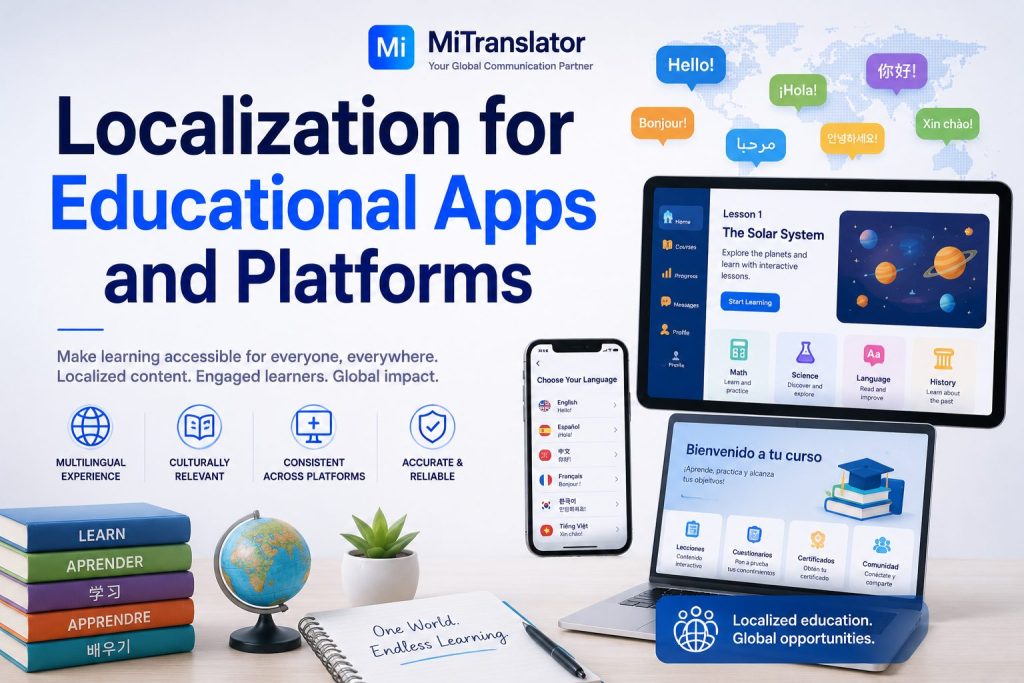
The global e-learning market continues to grow as educational institutions, EdTech companies, and corporate training providers increasingly rely on digital learning solutions. Educational apps and online learning platforms now serve students, educators, and professionals across multiple countries and languages.
However, simply translating an app’s content is often not enough to engage learners effectively. Educational platforms must provide culturally relevant, linguistically accurate, and user-friendly experiences that meet the expectations of diverse audiences. This is where localization plays a crucial role.
Localization for educational apps and platforms helps organizations adapt learning experiences to different languages, cultures, and regional requirements, making education more accessible and effective for learners worldwide.
What Is Localization for Educational Apps and Platforms?
Localization for educational apps and platforms involves adapting digital learning content, interfaces, and user experiences to meet the linguistic and cultural needs of specific target markets.
Localization typically includes:
- User interface translation
- Course content translation
- Multimedia localization
- Cultural adaptation
- Assessment localization
- Learning management system (LMS) localization
- Date, time, and number format adaptation
- Regional language customization
- Educational terminology adaptation
- Local compliance requirements
Unlike direct translation, localization ensures that learners feel the platform was designed specifically for their language and region.
Why Localization Matters in Educational Technology
Improving Learning Outcomes
Students learn more effectively when educational content is presented in a familiar language and cultural context.
Localized content helps learners:
- Understand concepts more clearly
- Retain information more effectively
- Complete courses with greater confidence
- Engage more actively in learning activities
Improved comprehension often leads to better educational outcomes.
Expanding Global Reach
Educational apps and platforms can attract users from multiple countries through localization.
By offering content in multiple languages, organizations can enter new markets and increase adoption among international learners.
Enhancing User Experience
A fully localized platform creates a smoother learning experience by adapting:
- Navigation menus
- Instructions
- Notifications
- Interactive activities
- Learning resources
Users are more likely to continue using a platform that feels intuitive and relevant to their needs.
Supporting Inclusive Education
Localization helps remove language barriers and promotes equal access to educational opportunities.
This is particularly important for schools, universities, and organizations seeking to serve diverse student populations.
Common Elements That Require Localization
User Interface (UI)
Educational platforms often contain extensive interface elements such as:
- Menus
- Buttons
- Dashboards
- Navigation tools
- Notifications
UI localization improves usability and learner satisfaction.
Course Content
Learning materials may include:
- Lessons
- Assignments
- Presentations
- Reading materials
- Interactive exercises
Accurate localization ensures educational consistency across languages.
Multimedia Resources
Many educational platforms incorporate:
- Videos
- Audio lessons
- Animations
- Interactive simulations
- Infographics
These elements often require subtitles, voiceovers, or culturally appropriate adaptations.
Assessments and Examinations
Quizzes, tests, and assessments must be localized carefully to preserve:
- Learning objectives
- Difficulty levels
- Grading criteria
- Instruction clarity
This helps maintain fairness and educational integrity.
Student Support Resources
Educational apps frequently provide:
- Help centers
- FAQs
- User guides
- Customer support documentation
Localized support materials improve user confidence and reduce confusion.
Challenges in Educational App Localization
Cultural Adaptation
Examples, illustrations, and references that work in one country may not be relevant in another.
Localization often requires adapting:
- Cultural references
- Examples
- Case studies
- Visual content
- Learning scenarios
Subject-Specific Terminology
Educational content frequently includes specialized terminology related to:
- Science
- Technology
- Engineering
- Mathematics
- Business
- Healthcare
Accurate translation is essential to preserve educational value.
Maintaining Consistency Across Languages
Large educational platforms may contain thousands of content elements.
Without proper terminology management, inconsistencies can affect learning quality and user experiences.
Technical Constraints
Different languages vary in length and structure.
Localization teams must ensure that translated text fits properly within user interfaces without affecting functionality.
Continuous Content Updates
Educational content is frequently updated to reflect new information, curriculum changes, and feature improvements.
Organizations must maintain synchronization across all localized versions.
Best Practices for Educational App Localization
Plan for Localization Early
Educational platforms should be designed with multilingual support in mind from the beginning.
This makes future localization efforts more efficient and cost-effective.
Work with Educational Localization Specialists
Localization providers with experience in education understand instructional design principles, learner expectations, and academic terminology.
This expertise helps preserve educational effectiveness.
Create Terminology Glossaries
Standardized glossaries help maintain consistency across courses, lessons, assessments, and support materials.
Localize Multimedia Content
Videos, voiceovers, subtitles, graphics, and interactive elements should be adapted alongside written content to provide a complete learning experience.
Conduct Linguistic and Functional Testing
Testing should verify:
- Translation quality
- User interface functionality
- Multimedia synchronization
- Assessment accuracy
- Platform usability
Quality assurance helps ensure a seamless learning experience.
Educational Platform Localization Checklist
Before launching a localized educational platform, ensure that you:
✔ Translate all user interface elements professionally
✔ Localize educational content accurately
✔ Adapt cultural references and examples
✔ Maintain terminology consistency
✔ Localize videos and multimedia resources
✔ Review assessments and examinations carefully
✔ Test platform functionality across languages
✔ Update localized content regularly
✔ Conduct comprehensive quality assurance reviews
✔ Gather learner feedback after launch
How MITRANS Can Help
Educational platform localization requires a combination of linguistic expertise, cultural knowledge, and instructional understanding.
MITRANS provides professional localization services for:
- Educational applications
- E-learning platforms
- Learning management systems (LMS)
- Online training programs
- Educational websites
- Mobile learning apps
- Corporate learning platforms
- Academic content
- Multimedia learning resources
- Student support materials
Our experienced localization specialists help educational organizations create engaging, accurate, and culturally relevant learning experiences for global audiences.
Frequently Asked Questions
What is educational app localization?
Educational app localization involves adapting digital learning platforms and content for specific languages, cultures, and regional requirements.
Why is localization important for educational platforms?
Localization improves learner engagement, comprehension, accessibility, and overall educational effectiveness.
What is the difference between translation and localization?
Translation converts text into another language, while localization adapts content, design, and user experiences to suit a particular market.
Which educational content should be localized?
Organizations commonly localize user interfaces, course materials, assessments, videos, support documentation, and learning resources.
Can machine translation be used for educational apps?
Machine translation may assist with basic content, but professional localization is recommended to ensure educational accuracy and cultural relevance.
Conclusion
As digital education continues to expand worldwide, localization has become essential for delivering meaningful learning experiences across languages and cultures. Educational organizations that invest in professional localization can improve learner engagement, expand into new markets, and provide more inclusive access to education.
By combining accurate translation, cultural adaptation, and technical expertise, educational apps and platforms can successfully connect with learners around the globe.
Need Localization Support for Your Educational App or Platform?
Looking to localize e-learning courses, educational apps, learning management systems, or digital training platforms for global audiences?
Contact MITRANS today for fast, accurate, and professional localization services tailored to EdTech companies, educational institutions, corporate training providers, online learning platforms, and global education organizations.