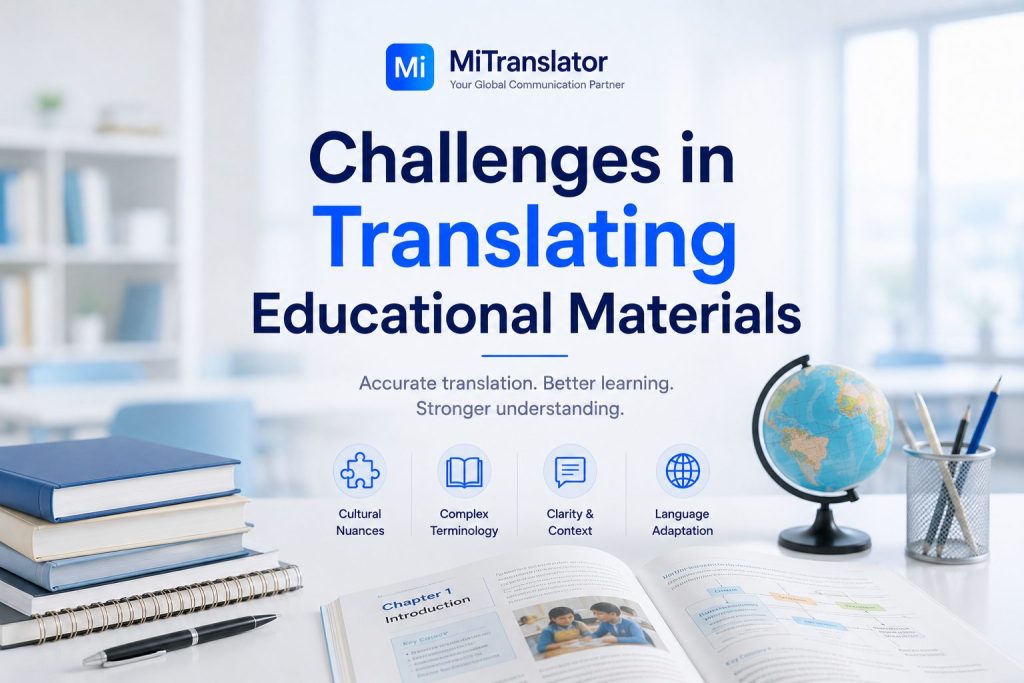
As education becomes increasingly globalized, schools, universities, e-learning providers, educational publishers, and training organizations are reaching learners from diverse linguistic and cultural backgrounds. To make educational content accessible and effective, many institutions rely on professional translation services to adapt learning materials into multiple languages.
However, translating educational materials is far more complex than simply converting words from one language to another. Educational content must preserve meaning, maintain instructional effectiveness, and remain culturally appropriate for the target audience.
From textbooks and curriculum guides to online courses and training manuals, translators face numerous challenges that can affect learning outcomes if not handled correctly. Understanding these challenges is essential for organizations seeking to deliver high-quality multilingual educational experiences.
What Is Educational Material Translation?
Educational material translation involves converting learning content from one language into another while maintaining educational accuracy, clarity, and cultural relevance.
Common educational materials include:
- Textbooks
- Course materials
- Curriculum guides
- E-learning modules
- Training manuals
- Student handbooks
- Academic assessments
- Learning management system (LMS) content
- Educational videos
- Teacher resources
The primary objective is to ensure that learners receive the same educational value regardless of the language in which the content is presented.
Why Accurate Educational Translation Matters
Supporting Effective Learning
Students must clearly understand concepts, instructions, and learning objectives.
Poor translation can create confusion, reduce comprehension, and negatively impact academic performance.
Accurate educational translation helps learners engage confidently with course content.
Expanding Access to Education
Educational institutions increasingly serve international students and multilingual communities.
Translated educational materials help make learning opportunities more accessible to diverse audiences.
Improving Student Engagement
Students are more likely to remain engaged when educational content is presented in their preferred language.
Well-localized materials can improve participation, retention, and overall learning outcomes.
Supporting Global Educational Programs
Universities, online learning platforms, and corporate training providers often deliver courses across multiple countries.
Professional translation ensures consistency and quality throughout international educational initiatives.
Common Challenges in Translating Educational Materials
Preserving Educational Meaning
Educational content is designed to teach specific concepts and skills.
Direct translation may not always communicate ideas effectively, especially when explaining complex topics.
Translators must preserve the educational intent while ensuring clarity for learners.
Cultural Differences
Educational examples, references, and learning activities often reflect the culture of the original audience.
Examples involving local history, traditions, humor, or social norms may not resonate with learners in other regions.
Localization is often necessary to make content culturally relevant and meaningful.
Subject-Specific Terminology
Educational materials frequently contain specialized terminology in fields such as:
- Science
- Mathematics
- Engineering
- Medicine
- Law
- Business
Accurate translation requires subject matter expertise to ensure technical concepts are communicated correctly.
Maintaining Age-Appropriate Language
Educational content is often designed for specific age groups.
Language that is appropriate for university students may be too complex for younger learners, while overly simplified language may not meet academic requirements.
Translators must adapt content to suit the target audience’s educational level.
Translating Assessments and Examinations
Tests, quizzes, and assessments present unique challenges.
Questions must be translated carefully to ensure that difficulty levels, instructions, and intended learning outcomes remain consistent across languages.
Poorly translated assessments can affect fairness and validity.
Multimedia and E-Learning Localization
Modern educational content often includes:
- Videos
- Interactive exercises
- Audio recordings
- Animations
- Learning platforms
Translating multimedia content requires additional localization efforts to ensure a seamless learning experience.
Best Practices for Translating Educational Materials
Work with Educational Translation Specialists
Educational content should be translated by professionals who understand both language and instructional design principles.
Specialized translators can better preserve learning objectives and educational effectiveness.
Localize Examples and Cultural References
When appropriate, examples, case studies, and references should be adapted to reflect the cultural context of the target audience.
Localization improves learner engagement and understanding.
Develop Consistent Terminology
Creating glossaries for educational terms helps maintain consistency across textbooks, courses, assessments, and learning resources.
Consistency is particularly important for technical and academic subjects.
Conduct Educational Quality Reviews
Educational translations should undergo review processes that assess:
- Accuracy
- Clarity
- Terminology consistency
- Cultural appropriateness
- Learning effectiveness
Quality assurance helps ensure that translated content meets educational goals.
Test E-Learning Content
For digital learning platforms, testing should verify:
- Text display
- User interface functionality
- Multimedia synchronization
- Interactive elements
- Navigation consistency
This helps provide a smooth learning experience across languages.
Educational Translation Checklist
Before publishing translated educational materials, ensure that you:
✔ Preserve original learning objectives
✔ Verify terminology accuracy
✔ Adapt cultural references when appropriate
✔ Maintain age-appropriate language
✔ Review assessments carefully
✔ Ensure consistency across all content
✔ Localize multimedia elements
✔ Conduct educational quality reviews
✔ Test digital learning platforms
✔ Perform final proofreading before release
How MITRANS Can Help
Educational translation requires linguistic expertise, subject matter knowledge, and an understanding of how people learn.
MITRANS provides professional translation and localization services for:
- Textbooks
- Academic materials
- E-learning courses
- Training programs
- Educational websites
- Student handbooks
- Assessments and examinations
- Curriculum documentation
- Learning management systems
- Multimedia educational content
Our experienced translators help educational institutions and training providers create accurate, engaging, and culturally appropriate learning experiences for global audiences.
Frequently Asked Questions
Why is educational translation different from general translation?
Educational translation must preserve learning objectives, instructional effectiveness, and student comprehension while maintaining accuracy and cultural relevance.
What types of educational content commonly require translation?
Common examples include textbooks, course materials, e-learning modules, training manuals, student guides, examinations, and educational videos.
Why is localization important in education?
Localization helps adapt examples, cultural references, and communication styles to make content more relevant and understandable for learners.
Can machine translation be used for educational materials?
Machine translation may assist with basic understanding, but professional human translation is recommended for educational content where accuracy and learning outcomes are important.
How can organizations ensure consistency across translated educational materials?
Using terminology glossaries, translation memory tools, and professional review processes helps maintain consistency across all learning resources.
Conclusion
Translating educational materials involves far more than language conversion. Educational content must remain accurate, engaging, culturally appropriate, and effective in helping learners achieve their goals.
By understanding the challenges involved and investing in professional educational translation services, organizations can improve accessibility, support global learning initiatives, and deliver meaningful educational experiences across languages and cultures.
Need Professional Translation for Educational Materials?
Looking to translate textbooks, e-learning courses, training programs, academic resources, or educational content for international learners?
Contact MITRANS today for fast, accurate, and professional educational translation and localization services tailored to schools, universities, training providers, educational publishers, and e-learning organizations.