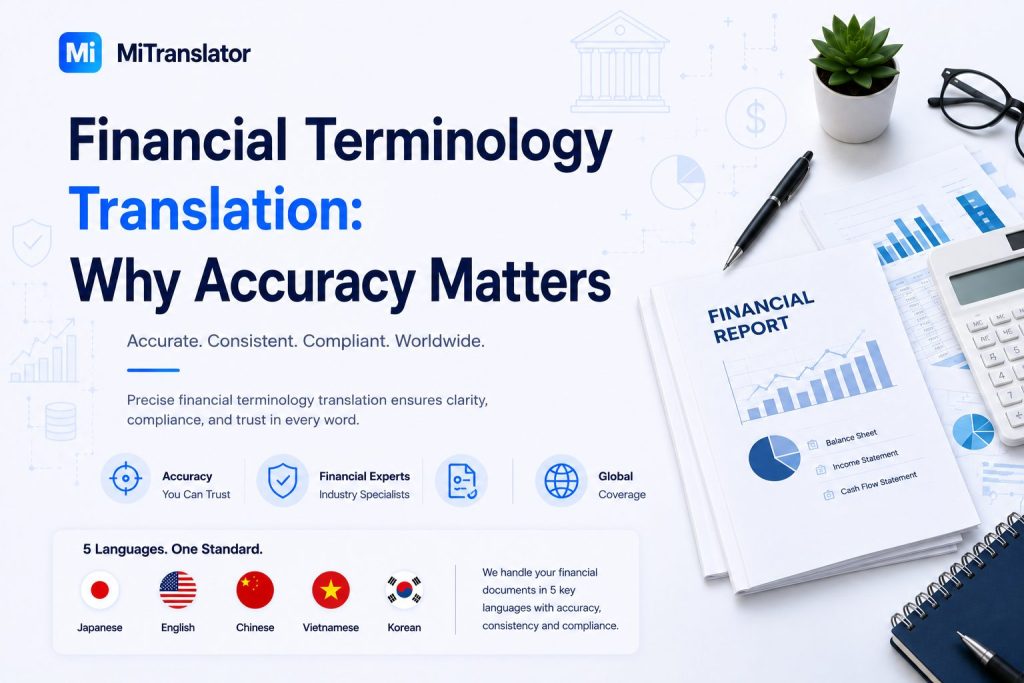
In today’s global financial environment, businesses regularly communicate with international investors, banking institutions, regulators, and customers across multiple languages. Financial documents, reports, contracts, and digital platforms often contain highly specialized terminology that requires precise translation.
A single mistranslated financial term can lead to misunderstandings, compliance issues, financial losses, or damage to a company’s reputation. This is why financial terminology translation plays a critical role in ensuring clear communication and maintaining trust in international financial operations.
Whether translating annual reports, investment materials, banking documents, or regulatory filings, organizations must ensure that financial terminology is conveyed accurately across languages. In this article, we’ll explore why accuracy matters, the challenges involved, and the best practices for achieving high-quality financial translations.
What Is Financial Terminology Translation?
Financial terminology translation is the process of accurately translating specialized financial language from one language to another while preserving its meaning, regulatory context, and technical accuracy.
This type of translation commonly applies to:
- Financial statements
- Annual reports
- Audit reports
- Investment documents
- Banking materials
- Insurance policies
- Securities disclosures
- Tax documentation
- FinTech content
- Regulatory filings
Unlike general translation, financial terminology translation requires a strong understanding of accounting principles, financial instruments, industry standards, and legal requirements.
Why Accurate Financial Terminology Translation Matters
Preventing Costly Misunderstandings
Financial terminology often carries highly specific meanings that may not have direct equivalents in another language.
Terms such as “equity,” “liability,” “asset impairment,” and “working capital” require precise interpretation. Even minor translation errors can lead to misunderstandings among investors, clients, regulators, and business partners.
Accurate terminology ensures that financial information remains clear and reliable.
Supporting Regulatory Compliance
Many financial documents must comply with regulations in multiple jurisdictions.
Errors in translated compliance reports, disclosure statements, or regulatory filings may result in:
- Regulatory penalties
- Delayed approvals
- Legal complications
- Reputational damage
Professional financial translation helps organizations meet legal requirements while minimizing compliance risks.
Building Investor Confidence
Investors depend on accurate financial information when evaluating opportunities and making strategic decisions.
Consistent and precise translation of financial terminology enhances transparency and demonstrates professionalism, helping businesses establish trust with international stakeholders.
Facilitating Global Business Operations
As companies expand internationally, they must communicate effectively with foreign investors, banks, regulators, and partners.
Accurate financial translation supports smoother transactions, stronger business relationships, and more efficient cross-border operations.
Common Challenges in Financial Terminology Translation
Specialized Industry Language
Financial documents contain technical concepts that require industry-specific knowledge.
Translators often encounter terminology related to:
- Accounting standards
- Corporate finance
- Investment management
- Banking operations
- Tax regulations
- Insurance products
Without subject matter expertise, critical nuances may be lost during translation.
Differences in Regulatory Frameworks
Financial regulations vary significantly between countries.
A financial term used in one market may have a different legal or accounting interpretation in another, making contextual understanding essential.
Rapid Industry Evolution
The financial sector continuously introduces new products, technologies, and concepts.
Examples include:
- Digital assets
- Blockchain technology
- Open banking
- Sustainable finance
- Embedded finance
Financial translators must stay informed about emerging terminology and industry developments.
Maintaining Consistency Across Documents
Large organizations often produce substantial volumes of financial content.
Inconsistent terminology across reports, presentations, disclosures, and communications can create confusion and reduce credibility.
Best Practices for Financial Terminology Translation
Work with Financial Translation Specialists
Financial translation should be handled by professionals who understand both language and finance.
Experienced financial translators can accurately interpret industry terminology and ensure contextually appropriate translations.
Develop a Terminology Glossary
Creating a centralized glossary of approved financial terms helps maintain consistency across all translated materials.
A well-managed glossary also improves efficiency and reduces the likelihood of terminology errors.
Use Translation Memory Technology
Translation memory tools store previously approved translations for future use.
This helps organizations maintain consistent terminology across recurring documents such as annual reports, compliance materials, and investor communications.
Implement Comprehensive Quality Assurance
Financial translations should undergo multiple review stages, including:
- Linguistic review
- Terminology verification
- Compliance checks
- Proofreading
- Formatting review
Thorough quality assurance helps minimize risks and improve overall accuracy.
Stay Updated on Regulatory Changes
Financial terminology evolves alongside changes in regulations, accounting standards, and market practices.
Regular updates to translation resources and glossaries help ensure ongoing accuracy and compliance.
Financial Terminology Translation Checklist
Before publishing translated financial content, ensure that you:
✔ Verify all financial terminology
✔ Use industry-approved translations
✔ Maintain consistency across documents
✔ Review regulatory and compliance language
✔ Validate accounting and reporting terms
✔ Conduct professional proofreading
✔ Use terminology glossaries and translation memory tools
✔ Ensure clarity for international audiences
✔ Update translations to reflect current regulations
✔ Perform final quality assurance reviews
How MITRANS Can Help
Financial translation requires more than language proficiency—it demands industry expertise, regulatory awareness, and meticulous attention to detail.
MITRANS provides professional financial translation services for:
- Financial statements
- Annual reports
- Audit reports
- Banking documentation
- Investment materials
- Insurance documents
- Regulatory filings
- FinTech content
- Corporate finance communications
Our experienced linguists combine language expertise with financial knowledge to deliver accurate, consistent, and confidential translations that support international business success.
Frequently Asked Questions
Why is financial terminology translation different from general translation?
Financial translation involves specialized terminology, regulatory requirements, and technical concepts that require industry-specific expertise and contextual understanding.
What documents typically require financial translation?
Common examples include annual reports, financial statements, audit reports, investment prospectuses, banking agreements, insurance policies, and regulatory filings.
Can machine translation accurately handle financial terminology?
Machine translation may provide a basic understanding of content, but professional human translation is strongly recommended for financial documents where precision is essential.
How can businesses maintain consistency in financial translations?
Organizations can maintain consistency by using terminology glossaries, translation memory tools, and professional review processes.
Why is terminology accuracy important in financial reporting?
Accurate terminology helps stakeholders correctly interpret financial information, supports compliance efforts, improves transparency, and strengthens credibility.
Conclusion
Accurate financial terminology translation is essential for effective communication in today’s global financial marketplace. Whether preparing investor reports, regulatory filings, banking documents, or FinTech content, organizations must ensure that specialized terminology is translated with precision and consistency.
By investing in professional financial translation services, businesses can reduce risk, strengthen compliance, build investor confidence, and support successful international growth.
Need Professional Financial Translation Services?
Looking to translate financial documents, reports, compliance materials, or investor communications with accuracy and consistency?
Contact MITRANS today for fast, accurate, and professional financial translation services tailored to banks, investment firms, insurance providers, FinTech companies, accounting organizations, and multinational enterprises.