Real estate transactions often involve substantial financial investments, complex legal documentation, and strict regulatory requirements. Whether purchasing residential property, acquiring commercial real estate, leasing office space, or investing in development projects, all parties involved must clearly understand the legal documents governing the transaction.
As international real estate investment continues to grow, buyers, sellers, developers, law firms, and real estate agencies increasingly deal with multilingual legal documents. In these situations, accurate legal translation becomes essential. Even minor translation errors can lead to misunderstandings, contractual disputes, regulatory issues, or financial losses.
Professional legal translation helps ensure that all parties fully understand their rights, obligations, and responsibilities throughout the transaction process. This article explores the importance of legal translation for real estate transactions, common challenges, best practices, and how professional language services support successful property deals.
What Is Legal Translation for Real Estate Transactions?
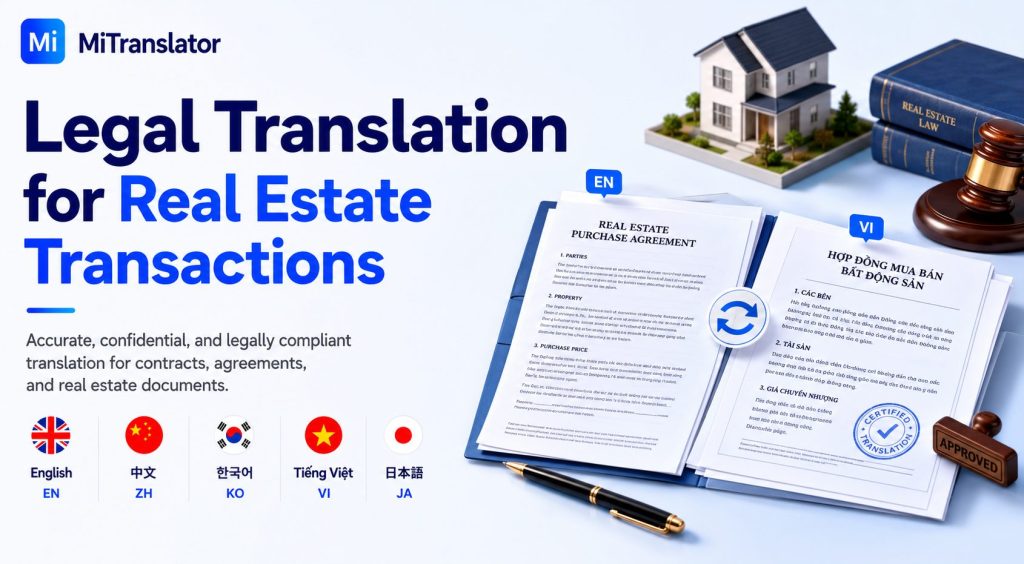
Legal translation for real estate transactions involves translating property-related legal documents from one language into another while preserving their legal meaning, accuracy, and enforceability.
Real estate transactions often require translation of documents such as:
- Sale and purchase agreements
- Property transfer contracts
- Lease agreements
- Property ownership certificates
- Land use rights documents
- Title deeds
- Mortgage agreements
- Property management contracts
- Due diligence reports
- Investment agreements
- Construction contracts
- Legal disclosures
- Government approvals and permits
Unlike general business translation, legal translation requires specialized knowledge of legal terminology, real estate law, and jurisdiction-specific regulations.
Legal translators must accurately convey the original meaning without introducing ambiguity or altering contractual obligations. Because many real estate documents have legal consequences, precision is critical.
For international investors and cross-border transactions, legal translation serves as a bridge between different legal systems and languages, helping all parties make informed decisions.
Why Legal Translation Matters for Real Estate Transactions
Protects Legal Accuracy
Real estate contracts contain legally binding provisions that define ownership rights, payment obligations, responsibilities, and dispute resolution procedures.
Translation errors can alter the interpretation of these provisions and create legal complications.
Supports International Investment
Foreign investors often rely on translated documents to evaluate opportunities and complete transactions.
Accurate legal translation allows investors to understand property details and legal commitments before signing agreements.
Reduces Risk of Disputes
Misunderstandings caused by inaccurate translations can result in disagreements between buyers, sellers, landlords, tenants, or investors.
Professional translation helps ensure that all parties share the same understanding of contractual terms.
Facilitates Regulatory Compliance
Many jurisdictions require translated documents for registration, licensing, taxation, or government approvals.
Accurate translations help organizations meet legal and administrative requirements.
Improves Due Diligence Processes
Investors and legal advisors frequently review large volumes of documentation before completing transactions.
Professional translations help streamline due diligence and support informed decision-making.
Builds Trust Between Parties
Clear communication is essential in high-value transactions.
Accurate legal translation promotes transparency and strengthens confidence among stakeholders.
Common Challenges in Legal Translation for Real Estate Transactions
Complex Legal Terminology
Real estate contracts often contain highly specialized legal language.
Terms related to:
- Ownership rights
- Easements
- Encumbrances
- Mortgages
- Leases
- Land use rights
may not have direct equivalents in another language.
Translators must understand both legal systems to ensure accuracy.
Differences Between Legal Systems
Property laws vary significantly across jurisdictions.
A legal concept recognized in one country may not exist in another, making translation particularly challenging.
Maintaining Contractual Precision
Legal documents require exact wording.
Even small wording changes can affect how a contract is interpreted and enforced.
Large Volumes of Documentation
Complex transactions often involve numerous contracts, certificates, reports, and supporting documents.
Managing consistency across these materials requires structured translation processes.
Confidentiality Requirements
Real estate transactions frequently involve sensitive financial and personal information.
Translation providers must maintain strict confidentiality and data security standards.
Tight Transaction Timelines
Property transactions often operate under strict deadlines.
Legal translation services must balance speed with accuracy to support timely closings.
Best Practices for Legal Translation in Real Estate Transactions
Use Specialized Legal Translators
Legal translation should always be handled by professionals with expertise in legal and real estate terminology.
Specialized translators understand the nuances of legal language and industry-specific requirements.
Develop Standardized Terminology
Create multilingual glossaries covering:
- Real estate terminology
- Property ownership concepts
- Contract terminology
- Financial terms
- Regulatory language
Consistent terminology improves clarity and reduces risk.
Conduct Multilevel Quality Reviews
Legal documents should undergo rigorous review procedures, including:
- Translation review
- Legal terminology verification
- Consistency checks
- Formatting validation
Quality assurance helps ensure reliability.
Preserve Original Meaning
Legal translation should focus on conveying legal intent rather than producing literal word-for-word translations.
Maintaining the original legal meaning is essential.
Protect Confidential Information
Implement secure workflows for handling:
- Property records
- Financial information
- Personal data
- Confidential contracts
Confidentiality agreements and secure file management systems are highly recommended.
Work Closely With Legal Advisors
In complex transactions, collaboration between translators and legal professionals can help resolve terminology issues and ensure compliance with local regulations.
Legal Translation Checklist for Real Estate Transactions
Before finalizing translated documents, verify that:
- Legal terminology is accurate.
- Contract provisions remain unchanged.
- Property details are correctly translated.
- Regulatory references are clear.
- Confidential information is protected.
- Formatting matches the original document.
- Quality assurance reviews have been completed.
How MITRANS Can Help
Real estate transactions require legal translations that are accurate, consistent, confidential, and professionally reviewed. Mistakes in legal documents can create significant financial and legal risks for all parties involved.
MITRANS provides professional legal translation services for real estate agencies, developers, investors, law firms, property management companies, and international buyers.
Our services include:
- Real estate contract translation
- Property ownership document translation
- Lease agreement translation
- Mortgage document translation
- Investment agreement translation
- Due diligence report translation
- Construction contract translation
- Regulatory document translation
- Certified legal translation
- Legal review and quality assurance
Our experienced legal translators understand both real estate terminology and legal documentation requirements, ensuring that translated content remains accurate and legally reliable.
With expertise in English, Vietnamese, Chinese, Japanese, Korean, French, German, and many other languages, MITRANS helps clients navigate multilingual real estate transactions with confidence.
Frequently Asked Questions About Legal Translation for Real Estate Transactions
Why is legal translation important in real estate transactions?
Legal translation ensures that all parties understand contractual obligations, ownership rights, and transaction terms, reducing risks and supporting informed decision-making.
Which real estate documents typically require legal translation?
Common examples include purchase agreements, lease contracts, title deeds, land use rights certificates, mortgage agreements, investment contracts, and due diligence reports.
Can machine translation be used for legal real estate documents?
Machine translation is not recommended for legal documents because it may fail to accurately interpret legal terminology and contractual language.
What is the difference between legal translation and general translation?
Legal translation requires specialized knowledge of legal systems, terminology, and document structures to preserve legal meaning and accuracy.
How can businesses ensure confidentiality during legal translation?
Organizations should work with professional translation providers that follow strict confidentiality agreements, secure file handling procedures, and data protection practices.
Need Legal Translation Support for Real Estate Transactions?
Looking to ensure accuracy, compliance, and clarity in multilingual property transactions and legal real estate documents?
Contact MITRANS today for fast, accurate, and professional legal translation services tailored to real estate developers, investors, law firms, property managers, and international buyers.