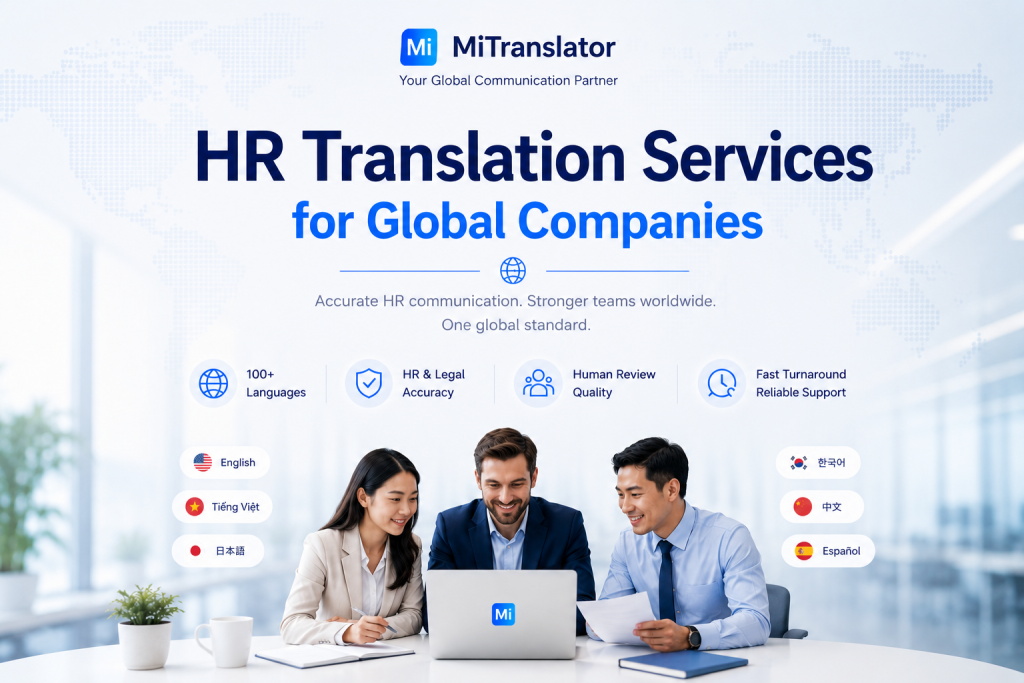
As companies continue expanding across international markets, multilingual workforce communication has become increasingly important for global HR operations. Businesses managing international employees, overseas recruitment, and cross-border teams often require professional HR translation services to support clear and consistent communication.
Modern global companies regularly localize:
- Employment contracts
- HR policies
- Recruitment materials
- Training programs
- Employee onboarding
- Internal communications
- Compliance documentation
- HR software platforms
Because HR communication directly impacts employees, legal compliance, and workplace experience, accurate translation plays a critical role in global business operations.
In this article, we explore why HR translation services matter for global companies, common multilingual HR challenges, and how professional localization workflows support international workforce management.
Why HR Translation Matters for Global Companies
Global Workforces Require Multilingual Communication
International businesses increasingly manage:
- Cross-border teams
- Remote employees
- Overseas offices
- International recruitment
- Global HR systems
Professional translation helps organizations maintain clear communication across multilingual workplaces.
HR Documents Require Accuracy and Clarity
HR content often includes:
- Legal employment terms
- Workplace policies
- Compensation information
- Compliance requirements
- Employee rights and responsibilities
Translation errors may create:
- Employee misunderstandings
- Compliance risks
- Workplace confusion
- Legal complications
HR translation requires both linguistic accuracy and contextual understanding.
Employee Experience Depends on Communication
Employees are more comfortable and engaged when they can clearly understand:
- Company policies
- Training materials
- Internal announcements
- HR processes
- Benefits information
Localization improves employee trust and workplace accessibility.
International Recruitment Requires Localization
Global recruitment workflows often involve:
- Job descriptions
- Recruitment websites
- Candidate communication
- Interview documentation
- Employer branding materials
Localization helps businesses attract international talent more effectively.
Common HR Materials That Require Translation
Global companies frequently translate:
- Employment contracts
- Employee handbooks
- HR policies
- Training documentation
- Recruitment materials
- Internal communications
- Compliance documentation
- Payroll information
- Benefits documentation
- HR software interfaces
- Onboarding materials
- Performance review forms
These materials require both HR terminology expertise and culturally appropriate communication.
Common Challenges in HR Translation
Legal and Compliance Terminology
HR content often includes:
- Employment law terminology
- Labor compliance language
- Workplace regulations
- Policy wording
Incorrect translation may create legal and operational risks.
Cultural Workplace Differences
Different regions may have different expectations regarding:
- Workplace communication
- Professional tone
- Employee engagement
- HR terminology
- Internal communication style
Localization helps communication feel more natural for employees.
Consistency Across Global Teams
Large organizations frequently manage:
- Multi-country HR systems
- International employee communication
- Shared HR platforms
- Enterprise-wide policy updates
Consistency is essential for global HR operations.
AI Translation Limitations
AI-assisted translation improves speed, but raw machine translation may:
- Misinterpret HR terminology
- Produce awkward workplace language
- Create inconsistent communication
- Reduce policy clarity
Human review remains essential for employee-facing HR content.
What Professional HR Translation Services Include
HR Localization
Professional HR localization focuses on:
- Clear employee communication
- Policy accuracy
- Cultural adaptation
- Workplace readability
- Consistent terminology
The goal is improving workforce communication quality.
Human QA Review
Professional review helps ensure:
- Natural communication
- HR terminology consistency
- Compliance clarity
- Employee-friendly wording
- Localization quality
Human review is especially important for internal communication and legal HR materials.
Translation Memory and Terminology Management
HR workflows often include:
- HR terminology databases
- Translation memory systems
- Company glossaries
- Brand tone consistency
These systems improve long-term multilingual communication quality.
Secure Enterprise Workflows
HR localization often requires:
- Confidential document handling
- Employee data protection
- Secure collaboration systems
- Enterprise-grade localization management
HR information requires strong privacy and security standards.
Industries That Frequently Need HR Translation
HR translation services are widely used across:
- International corporations
- Technology companies
- Manufacturing businesses
- Hospitality groups
- Healthcare organizations
- Retail companies
- Logistics providers
- Financial institutions
- SaaS businesses
- Global recruitment agencies
These organizations frequently manage multilingual workforce communication across international markets.
Best Practices for HR Localization
Use HR-Specialized Translators
HR translation requires:
- Employment terminology expertise
- Legal understanding
- Workplace communication experience
- HR industry knowledge
General translation may not be sufficient for HR materials.
Maintain Consistent HR Terminology
Businesses should standardize:
- HR terminology
- Internal communication wording
- Policy language
- Recruitment messaging
Consistency improves employee understanding and professionalism.
Combine AI Translation With Human Review
Modern HR localization workflows work best when combining:
- AI-assisted translation
- Human QA review
- Translation memory systems
- Terminology management
This improves both scalability and communication quality.
Localize the Entire Employee Experience
Companies should localize:
- Recruitment materials
- Onboarding processes
- HR systems
- Employee communication
- Internal training
Integrated multilingual communication improves global workforce operations.
How MITRANS Supports Global HR Teams
MITRANS Translator provides HR translation and localization services for international businesses operating across Vietnam and global markets.
Our services include:
- HR document translation
- Recruitment localization
- Employee communication localization
- HR software localization
- AI-assisted translation
- Human QA review
- Translation memory management
- Terminology management
- Enterprise localization workflows
MITRANS supports multiple language pairs, including:
- English ↔ Vietnamese
- Chinese ↔ Vietnamese
- Japanese ↔ Vietnamese
- Korean ↔ Vietnamese
- French ↔ Vietnamese
By combining professional linguistic expertise with structured localization systems and quality-controlled review workflows, MITRANS helps businesses improve multilingual workforce communication while maintaining clarity, consistency, and professionalism.
Frequently Asked Questions
Why is HR translation important for global companies?
HR translation supports multilingual workforce communication, legal compliance, employee experience, and international HR operations.
What HR materials commonly require translation?
Employment contracts, employee handbooks, recruitment materials, onboarding documentation, training content, and HR software interfaces commonly require translation.
Is AI translation enough for HR content?
AI translation improves efficiency, but professional human review remains essential for compliance clarity, HR terminology accuracy, and employee communication quality.
Does MITRANS support HR localization?
Yes. MITRANS provides HR translation and localization services for international companies, HR teams, recruitment platforms, and enterprise workforce operations.
Conclusion
As businesses continue building global workforces, professional HR translation services have become essential for multilingual communication, employee engagement, and international workforce management.
From recruitment materials and onboarding documentation to HR systems and internal communication, accurate localization helps companies create clearer, more consistent, and more accessible employee experiences across international markets.
Need Vietnamese Translation or Localization Support?
MITRANS helps global businesses manage multilingual communication, localization, and Vietnamese market operations with quality-controlled translation workflows.
Contact MITRANS Translator today for fast, accurate, and professional language solutions tailored to your business.