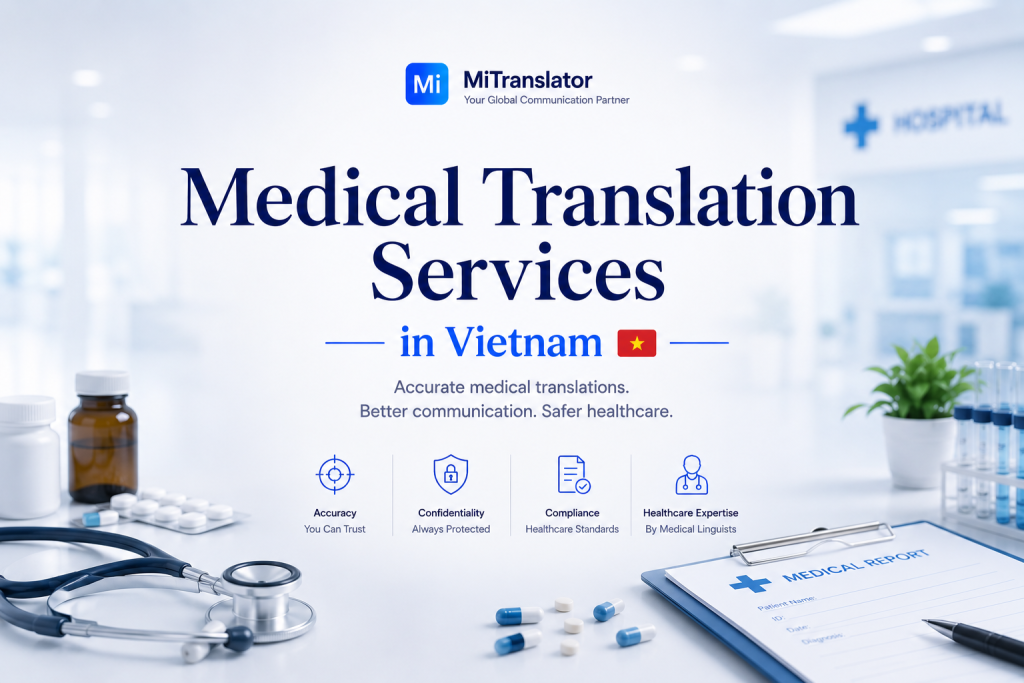
As Vietnam’s healthcare sector continues expanding internationally, professional medical translation services have become increasingly important for hospitals, healthcare providers, pharmaceutical companies, medical device manufacturers, and international patients.
Medical organizations regularly manage multilingual communication involving:
- Patient records
- Clinical documentation
- Medical research
- Pharmaceutical materials
- Healthcare software
- Regulatory documentation
- International healthcare partnerships
Because medical communication directly impacts patient safety and healthcare accuracy, professional medical translation requires both linguistic expertise and specialized medical knowledge.
In this article, we explore why medical translation services matter in Vietnam, common healthcare localization challenges, and how professional translation workflows improve multilingual healthcare communication.
Why Medical Translation Matters in Vietnam
Vietnam’s Healthcare Industry Is Becoming More International
Vietnam is seeing growth in:
- International healthcare services
- Medical tourism
- Pharmaceutical investment
- Healthcare technology
- Clinical research collaboration
- Cross-border healthcare partnerships
This creates increasing demand for multilingual healthcare communication.
Medical Accuracy Is Critical
Healthcare translation often involves:
- Medical terminology
- Clinical instructions
- Patient communication
- Regulatory information
- Prescription details
- Healthcare procedures
Translation errors may lead to:
- Miscommunication
- Treatment confusion
- Compliance risks
- Patient safety concerns
Medical translation requires extremely high accuracy standards.
International Patients Need Localized Communication
Hospitals and clinics in Vietnam increasingly serve:
- Foreign patients
- Medical tourists
- International insurance providers
- Overseas healthcare organizations
Professional translation improves patient experience and communication clarity.
Healthcare Technology Requires Localization
Healthcare systems often localize:
- Medical software
- Telemedicine platforms
- Patient portals
- Mobile health applications
- E-learning systems for healthcare staff
Localization improves usability for multilingual users.
Common Medical Documents That Require Translation
Healthcare organizations frequently translate:
- Medical reports
- Patient records
- Clinical trial documentation
- Prescription information
- Hospital forms
- Consent documents
- Medical device manuals
- Pharmaceutical materials
- Healthcare software interfaces
- Insurance documents
- Training materials
- Research papers
These materials require both technical and medical terminology expertise.
Common Challenges in Medical Translation
Complex Medical Terminology
Healthcare content often includes:
- Clinical terminology
- Pharmaceutical language
- Anatomical terms
- Diagnostic information
- Regulatory terminology
Incorrect translation may create serious risks.
Regulatory and Compliance Requirements
Medical documentation frequently requires:
- High accuracy
- Consistent terminology
- Regulatory alignment
- Structured formatting
Professional workflows are important for maintaining compliance quality.
Patient Communication Clarity
Medical translation must remain:
- Clear
- Easy to understand
- Contextually accurate
- Culturally appropriate
Patient-facing communication requires both precision and readability.
AI Translation Limitations
AI-assisted translation improves speed, but raw machine translation may:
- Misinterpret medical terminology
- Produce unsafe wording
- Reduce clinical clarity
- Create inconsistent terminology
Human medical review remains essential for healthcare localization.
What Professional Medical Translation Services Include
Specialized Medical Translation
Professional healthcare translation focuses on:
- Medical terminology accuracy
- Clinical clarity
- Regulatory consistency
- Patient readability
- Contextual understanding
Medical expertise is essential for quality healthcare communication.
Human QA Review
Professional review helps ensure:
- Terminology accuracy
- Clinical clarity
- Consistent wording
- Safe communication
- Natural localization
Human QA is especially important for patient-facing materials.
Translation Memory and Terminology Management
Healthcare workflows often include:
- Medical terminology databases
- Translation memory systems
- Approved healthcare glossaries
- Consistency management
These systems improve long-term localization quality.
Secure Localization Workflows
Medical translation often requires:
- Confidential document handling
- Data protection workflows
- Secure collaboration systems
- Enterprise-grade localization management
Security and confidentiality are critical in healthcare environments.
Industries That Frequently Need Medical Translation
Medical translation services are widely used across:
- Hospitals and clinics
- Pharmaceutical companies
- Healthcare startups
- Telemedicine platforms
- Medical device manufacturers
- Healthcare SaaS companies
- Clinical research organizations
- Insurance providers
- Healthcare training platforms
- Medical tourism businesses
These organizations frequently manage multilingual healthcare communication.
Best Practices for Medical Translation
Use Specialized Medical Translators
Medical translation requires:
- Healthcare expertise
- Clinical terminology knowledge
- Regulatory understanding
- Industry-specific experience
General translation may not be sufficient for healthcare content.
Maintain Consistent Medical Terminology
Healthcare organizations should standardize:
- Clinical terminology
- Medication names
- Patient communication
- Medical workflows
- Regulatory wording
Consistency improves communication quality and patient safety.
Combine AI Translation With Human Medical Review
Modern healthcare localization workflows work best when combining:
- AI-assisted translation
- Human medical QA review
- Translation memory systems
- Terminology management
This improves both scalability and translation quality.
Protect Sensitive Healthcare Data
Medical translation workflows should prioritize:
- Confidentiality
- Secure document handling
- Access control
- Data privacy compliance
Healthcare information requires strong security standards.
How MITRANS Supports Healthcare Organizations
MITRANS Translator provides medical translation and healthcare localization services for organizations operating across Vietnam and international healthcare markets.
Our services include:
- Medical document translation
- Clinical localization
- Healthcare software localization
- Pharmaceutical translation
- AI-assisted translation
- Human medical QA review
- Translation memory management
- Terminology management
- Enterprise localization workflows
MITRANS supports multiple language pairs, including:
- English ↔ Vietnamese
- Chinese ↔ Vietnamese
- Japanese ↔ Vietnamese
- Korean ↔ Vietnamese
- French ↔ Vietnamese
By combining professional linguistic expertise with structured localization systems and quality-controlled review workflows, MITRANS helps healthcare organizations improve multilingual communication while maintaining high accuracy standards.
Frequently Asked Questions
Why is medical translation important?
Medical translation supports accurate healthcare communication, patient safety, regulatory compliance, and multilingual healthcare operations.
What documents commonly require medical translation?
Medical reports, clinical documentation, pharmaceutical materials, healthcare software, patient records, and medical device manuals commonly require translation.
Is AI translation enough for healthcare content?
AI translation improves efficiency, but professional human medical review remains essential for terminology accuracy, clinical clarity, and patient safety.
Does MITRANS support medical localization?
Yes. MITRANS provides medical translation and healthcare localization services for hospitals, healthcare providers, pharmaceutical companies, and healthcare technology platforms.
Conclusion
As Vietnam’s healthcare industry becomes increasingly international, professional medical translation services have become essential for patient communication, healthcare accuracy, and multilingual operational support.
From clinical documentation and healthcare software to pharmaceutical materials and medical research, accurate localization helps healthcare organizations improve communication quality while maintaining patient safety and regulatory consistency.
Need Vietnamese Translation or Localization Support?
MITRANS helps global businesses manage multilingual communication, localization, and Vietnamese market operations with quality-controlled translation workflows.
Contact MITRANS Translator today for fast, accurate, and professional language solutions tailored to your business.