Introduction
Whether you need translation for:
- Business contracts
- Immigration paperwork
- Academic records
- Marketing materials
- Technical manuals
- Website content
proper document preparation can make a major difference in:
- Translation quality
- Turnaround time
- Formatting accuracy
- Overall project efficiency
Many businesses focus only on the translation itself, but poorly prepared files often create:
- Delays
- Miscommunication
- Formatting issues
- Additional revision work
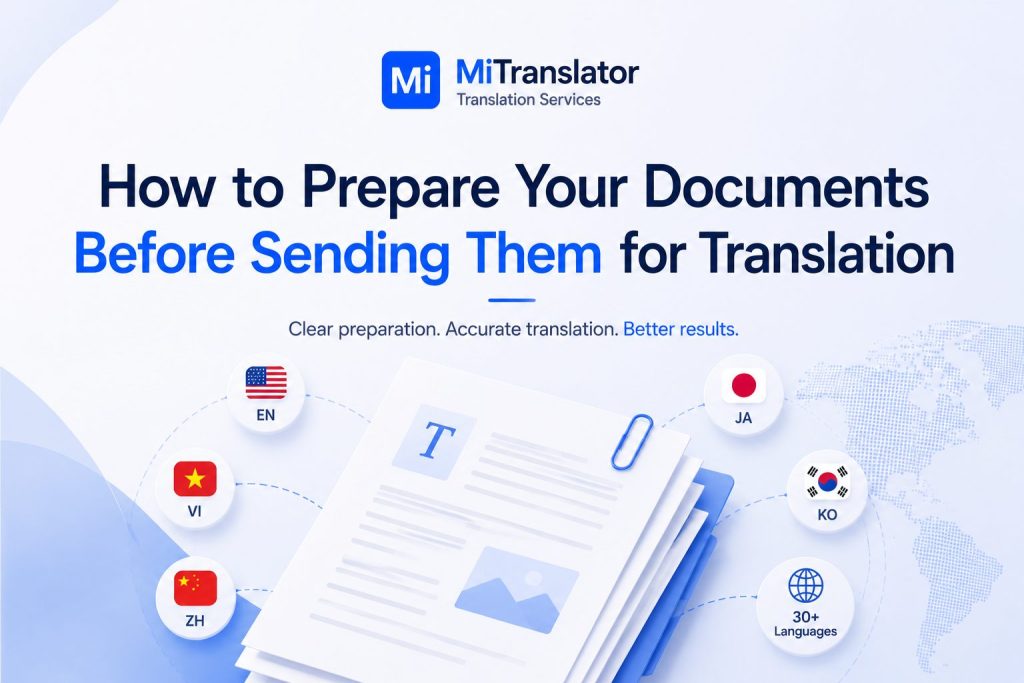
Preparing your documents correctly before sending them to a translation provider helps ensure smoother workflows and better multilingual communication.
This guide explains the most important steps businesses should take before starting a professional translation project.
Why Document Preparation Matters
Professional translation is not simply replacing words from one language with another.
Translators must understand:
- Context
- Terminology
- Audience expectations
- Formatting structure
- Communication goals
Clear and organized source files help translators work more accurately and efficiently.
Well-prepared documents also reduce production issues later in the process.
Use Editable File Formats
Whenever possible, provide editable source files such as:
- Word documents (.docx)
- Excel files (.xlsx)
- PowerPoint presentations (.pptx)
- Text-based PDFs
Editable files help:
- Speed up translation
- Preserve formatting
- Reduce layout errors
- Improve workflow efficiency
Avoid sending:
- Blurry screenshots
- Low-resolution scans
- Locked PDFs
- Cropped images
These may require additional OCR processing and formatting work.
Check Document Readability
Before sending files:
- Make sure all text is clear
- Verify pages are not cut off
- Check image quality
- Ensure scans are readable
Unreadable content may lead to:
- Translation mistakes
- Missing information
- Delays in delivery
Clear source material always improves translation accuracy.
Organize Files Clearly
If your project contains multiple documents:
- Use logical file names
- Separate folders by category
- Label versions properly
Examples:
- Product_Catalog_EN.docx
- Contract_Final_EN.pdf
- Website_Homepage_Content.docx
Good organization helps translation teams manage projects more efficiently.
Provide Context for Better Translation
Context helps translators understand:
- Intended meaning
- Brand voice
- Industry terminology
- Target audience
- Communication goals
Useful references may include:
- Website links
- Product descriptions
- Existing translations
- Brand guidelines
- Glossaries
Context is especially important for:
- Marketing localization
- SaaS localization
- Technical translation
- Vietnamese SEO localization
Share Terminology Preferences
Businesses often use specific terminology for:
- Product names
- Service descriptions
- Brand messaging
- Technical vocabulary
Providing glossaries or terminology lists helps ensure:
- Consistency
- Professional communication
- Better brand identity
Consistent terminology is critical for multilingual workflows.
Explain Your Target Audience
Translation quality improves significantly when translators know:
- Who the content is for
- The communication purpose
- The target market
For example:
- Vietnamese consumers
- International partners
- Government agencies
- Technical users
Localization depends heavily on audience expectations and communication style.
Clarify Formatting Requirements
Before starting the project, explain:
- Layout expectations
- File delivery format
- Certification needs
- Website structure requirements
- Design limitations
This helps reduce formatting revisions later.
Avoid Last-Minute Source Changes
Frequent edits after translation begins may:
- Slow down workflows
- Create inconsistencies
- Increase revision costs
Whenever possible:
- Finalize source content first
- Confirm approved versions internally
- Reduce unnecessary updates
This improves efficiency and quality control.
Why Localization Matters
Professional localization goes beyond direct translation.
Localization adapts:
- Tone
- User experience
- Cultural communication
- SEO structure
- Audience expectations
Vietnamese users often respond differently to:
- Business messaging
- Marketing language
- Calls-to-action
- Website content
Localization helps communication feel more natural and effective.
Common Mistakes Businesses Make
Sending Non-Editable Files Only
Image-based documents slow down workflows and increase formatting complexity.
Providing No Context
Without context, translators may misunderstand:
- Terminology
- Tone
- Product meaning
Ignoring Localization Needs
Direct translation alone may not work well for Vietnamese audiences.
Waiting Until the Last Minute
Rush projects increase:
- Workflow pressure
- Revision risk
- Quality control challenges
Early preparation improves results.
Translation vs Localization
| Translation | Localization |
|---|---|
| Converts language | Adapts communication for local audiences |
| Focuses on wording | Focuses on UX, culture & engagement |
| Basic multilingual support | Market-focused adaptation |
| Literal communication possible | Natural audience-focused communication |
Localization improves communication quality and customer engagement.
Why Proper Preparation Improves Translation Quality
Well-prepared documents help:
- Improve translation accuracy
- Reduce delays
- Simplify formatting
- Maintain terminology consistency
- Improve localization efficiency
This creates smoother multilingual communication and better business outcomes.
How MITRANS Can Help
MITRANS Translation Services provides professional translation and localization services for businesses worldwide.
MITRANS supports:
- Business document translation
- Certified translation
- Website localization
- SaaS localization
- Vietnamese SEO localization
- Marketing localization
- Technical translation
- Multilingual business workflows
Languages supported include:
- English
- Vietnamese
- Chinese
- Japanese
- Korean
Why businesses choose MITRANS:
- Native linguists
- Human quality assurance
- Localization-focused workflows
- Industry-specialized expertise
- Consistent terminology management
- Fast turnaround support
MITRANS helps businesses prepare, translate, and localize content professionally for international markets.
FAQ
Why should I send editable files for translation?
Editable files improve formatting accuracy, workflow efficiency, and turnaround speed.
Why is context important for translation quality?
Context helps translators understand tone, terminology, audience expectations, and intended meaning.
What file formats are best for translation?
Word, Excel, PowerPoint, and text-based PDFs are usually preferred.
Why should businesses prepare terminology lists?
Terminology lists improve consistency and strengthen brand communication across languages.
Does MITRANS provide localization support?
Yes. MITRANS provides professional translation and localization services tailored to international business communication.
Need Professional Translation & Localization Support?
Looking for accurate, organized, and business-focused multilingual communication?
Contact MITRANS today for professional translation and localization services tailored to your business goals.